Просмотр новости
Найдите то, что Вас интересует
 Спутники
 РН
РН SpaceX
 Роскосмос
 NASA
NASA
СпутникиРНSpaceXРоскосмосNASAThe Victorian painter drew on archaeology and ancient texts to create richly detailed scenes of love and excess.
The post How Sir Lawrence Alma-Tadema Imagined Ancient Rome appeared first on JSTOR Daily.
The icon indicates free access to the linked research on JSTOR.
A healthy portion of Sir Lawrence Alma-Tadema’s artworks recreates life in ancient Rome. Forget about military might, imperialism, and portrayals of heroic feats, though. His Rome is very much a hedonistic society. Through his paintings, “We are to be fascinated by the idle rich at their leisure, to delight with the revellers who carouse and the lovers who make love, and to marvel at the magnificence, opulence, and utter decadence,” writes Rosemary Barrow in Bulletin of the Institute of Classical Studies.


While his contemporaries indulged in Medieval-inspired imagery in their paintings, Sir Lawrence Alma-Tadema was more interested in depictions of Classical antiquity. “On an initial reading, many paintings appear little more than gorgeous depictions of marble, flowers, and Mediterranean sunlight, until we decipher the imagery, which invariably subverts apparent meaning,” writes Barrow.
Alma-Tadema also looked to historical, archaeological, and literary evidence for inspiration. In the realm of literature, “The texts chosen by Alma-Tadema are much the same as those employed by other British classical-subject painters: they are drawn from the witty, urbane, and carefree world of Latin love poetry: the poems of Catullus, the elegies of Tibullus, Propertius, and Ovid, and the Odes of Horace.” Catullus and Lesbia are frequent subjects of Alma-Tadema’s, as are Tibullus and his beloved Delia.
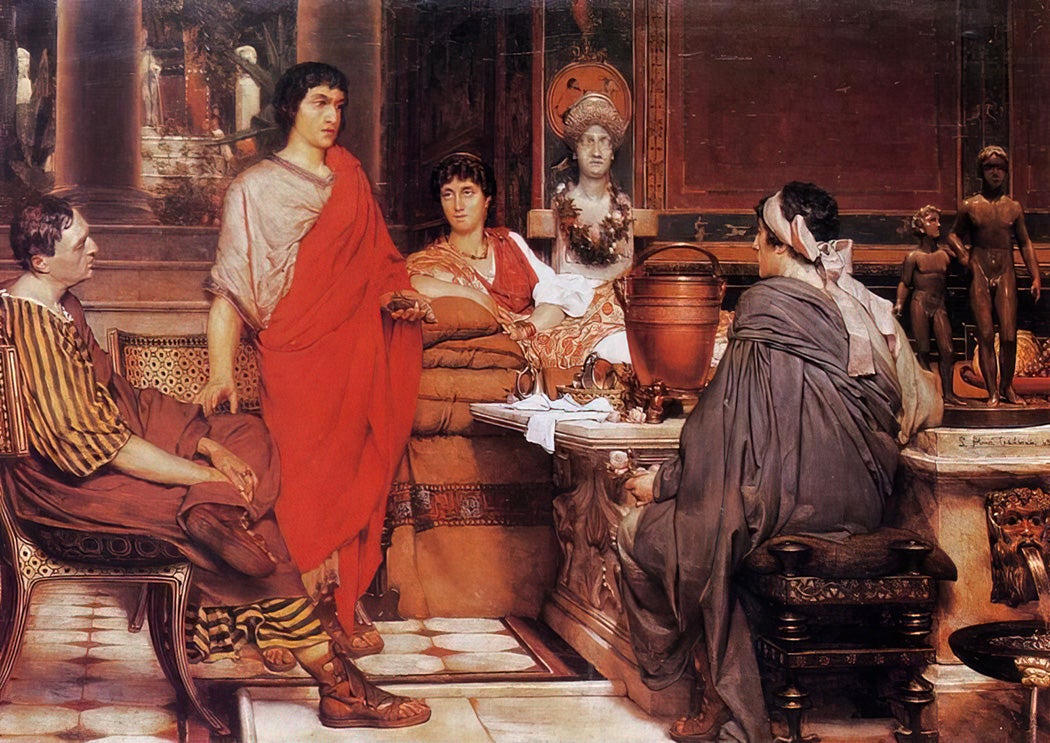 Catullus at Lesbia’s by Sir Lawrence Alma-Tadema, 1865. via Wikimedia Commons
According to Barrow, the first British painting to seek inspiration from Latin love poetry is Alma-Tadema’s Catullus at Lesbia’s of 1865, painted three years after Ludwig Schwabe’s influential biography of the poet, which surmised that Lesbia was the cultured, refined, and married aristocrat Clodia Metelli. “Lesbia’s house is portrayed as a richly decorated Pompeian interior, cluttered with expensive gold and silver plates and statuary, which, in addition to being decorative, serve to emphasize her wealth and status,” writes Barrow. A wall painting depicts a satyr anticipating copulation with a goat. “This is the most sexually explicit image ever used by any nineteenth-century British classical-subject painter.”
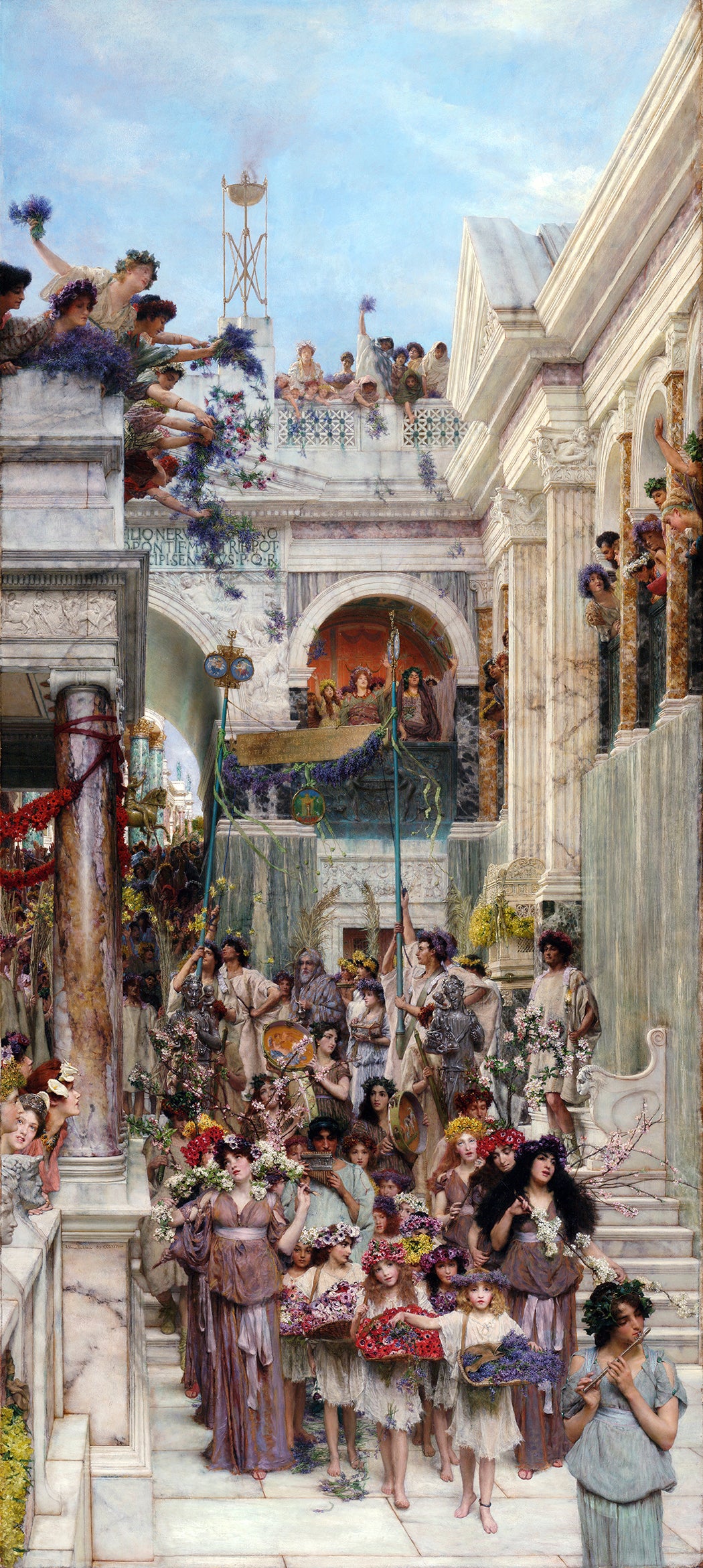 Spring by Sir Lawrence Alma-Tadema, 1894. via Wikimedia Commons
When it comes to archaeological sources, Spring depicts a procession headed by angelic flower girls winding its way through the marble-lined streets of imperial Rome. The occasion is the April Floralia, sacred to Flora, the ancient Italian goddess of flowers, vegetation, and fertility. “The painting presents a wealth of archaeological details: the roundels of the banner and tympana carried by the celebrants are decorated with paintings of semi-nude frolicking couples,” writes Barrow. “The roundel figures imitate nymphs and satyrs from a wall painting in the House of the Dioscuri, at Pompeii, while the tympana paintings imitate those from the House of the Vettii at Pompeii, excavated in 1894, the very year the painting was completed.”
Architectural and statuary elements aside, roses in particular bear a special significance in Alma-Tadema’s depiction of Roman life: he depicts women smelling roses; roses being presented as gifts; and roses also appear in the titles of his paintings. For Victorian audiences, this was a familiar motif. “The usual nineteenth-century association for roses was with beautiful girls and with sensuous love,” writes Barrow. Alma-Tadema, however, also sought to incorporate roses into his paintings with a focus on their significance in the Roman world.
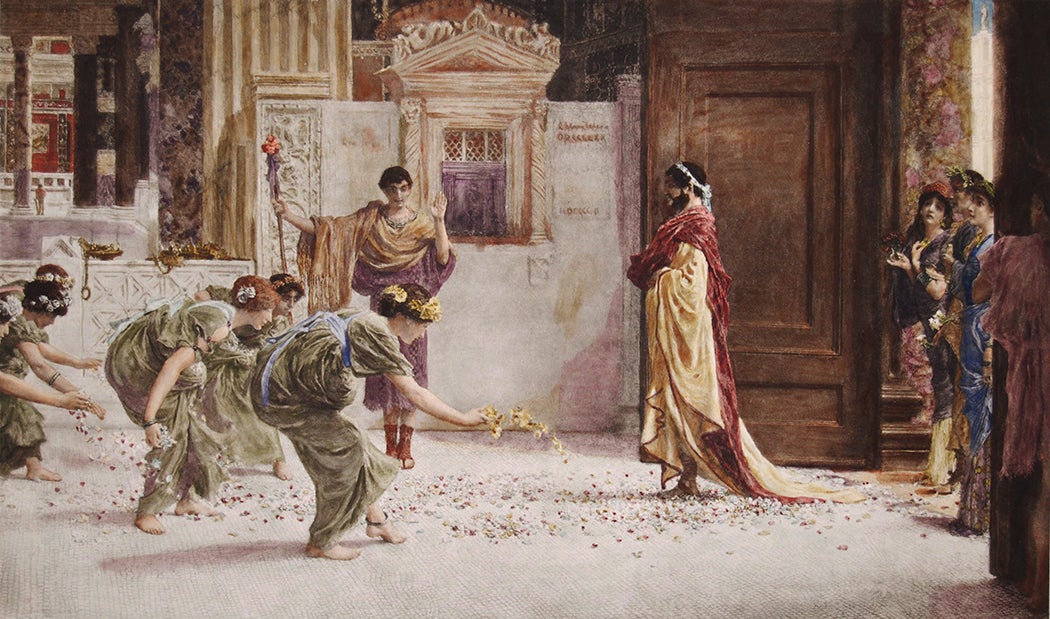 Caracalla by Sir Lawrence Alma-Tadema, 1902. via Wikimedia Commons
“For Alma-Tadema, roses mean love and revelry, but they also carry with them a distinctive Roman aura of excess,” Barrow says. Consider paintings like Caracalla, where the titular emperor treads a trail of rose petals; or In a Rose Garden, where a woman shakes the petals of a rose bush down on her companion; and the extravaganza of The Roses of Heliogabalus. “It was Athenaeus’ Cleopatra who once gave a banquet at which the guests were knee-deep in rose petals; Suetonius’ Nero who once demanded that a courtier spend over four million sesterces on roses for a dinner party in his honor; Tacitus’ Vitellius who visited a grisly battlefield after his path was strewn with rose petals.”
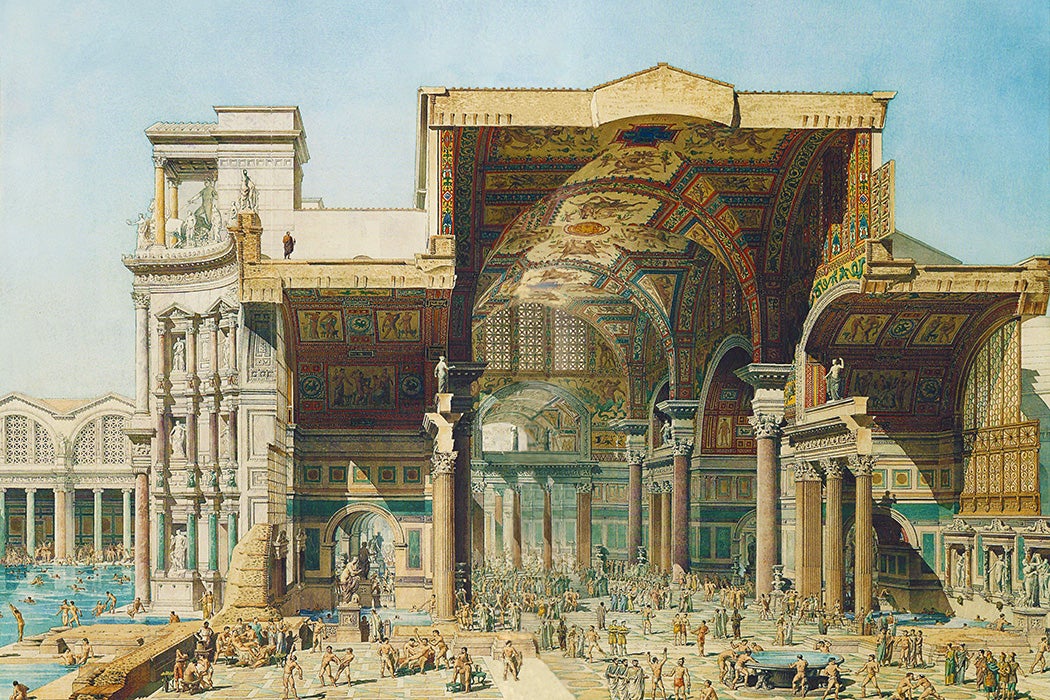
December 8, 2025
By the fourth century CE, Rome had some 856 privately owned public baths, the grounds of which served as civic gardens adorned with sculptures.
History, literature, and archaeology all coalesce in Alma-Tadema’s painting The Roses of Heliogabalus, which depicts a little-known episode from the Historia Augusta: “In a banqueting-room with a reversible ceiling Heliogabalus once overwhelmed his parasites with violets and other flowers, so that some of them were actually smothered to death, being unable to crawl out to the top.”
"*" indicates required fields
The emperor is wearing a tunic of silk and gold thread, while his dining couches are inlaid with silver and mother-of-pearl. “Other details are based on archaeological artefacts and, as usual, Alma-Tadema’s use of archaeology is not arbitrary, but contributes to the scene,” says Barrow. “In the background stands a bronze statue of Bacchus, faun, and panther, copied from an actual marble group in the Vatican Museums.”
The voluptuousness of the atmosphere evokes a mood of nineteenth-century literary decadence. “Théophile Gautier bitterly regrets that the richness of the antique world cannot be recaptured by the modern imagination and laments not having been a contemporary of Sardanapalus […] Heliogabalus, while Joris-Karl Huysmans describes Heliogabalus as treading in silver dust and sand of gold, his head crowned with a tiara and his clothes studded with jewels.”
The decadence extends beyond the subject matter: Alma-Tadema imported roses from the French Riviera to ensure a continual fresh supply while actively working on the painting.
Oddly, though, nobody in The Roses of Heliogabalus is smelling the roses. “His interest in Rome, ultimately, is vested in its corruption, luxury, and sensuality, and yet his access to all of this extravagance is essentially intellectual and conceptual,” concludes Barrow. This tension and paradox ultimately give his paintings a depth that the shiny textures and surfaces he portrays might, at first, conceal in the name of aestheticism.
| # | Наименование новости | Тональность | Информативность | Дата публикации |
|---|---|---|---|---|
| 1 | Reading the Maya with William S. Burroughs | 0 | 7.5 | 21-07-2026 |
| 2 | *Rome’s Age of Revolution* | 0 | 4.32 | 03-08-2026 |
| 3 | A hot poker to the Achilles tendon for lazy housework or mauled to death by lions: the life of a Roman slave | -2 | 7 | 14-06-2026 |
| 4 | The Debate Over Pictures in Science | 0 | 8.69 | 16-07-2026 |
| 5 | 7 признаков того, что перед вами скандинавская национально-романтическая живопись • Журнал | 0 | 16.01 | 05-05-2026 |
| 6 | Jiro Takamatsu, Oneness of Brick, 1971, paint on brick, 2 3/8 x 8 ½ x 4″. © The Estate of Jiro… | 0 | 30.28 | 20-07-2026 |
| 7 | crushed cars emerge from monumental archaeological landscape in ‘fossil opera’ | 0 | 3 | 10-07-2026 |
| 8 | deathandmysticism: Ottaviano Dandini, Detail of Witches at a... | 0 | 2 | 07-02-2026 |
| 9 | How We Brought an Art Gallery to Your Sunday Paper | 5 | 7 | 14-06-2026 |
| 10 | Что скрывалось за гениальностью да Винчи | 0 | 0 | 10-03-2021 |


