Просмотр новости
Найдите то, что Вас интересует
 Спутники
 РН
РН SpaceX
 Роскосмос
 NASA
NASA
СпутникиРНSpaceXРоскосмосNASAA T20 innings takes nearly two hours, while Tests span five days, creating a barrier for casual viewers. GEPL has changed the broadcast equation.
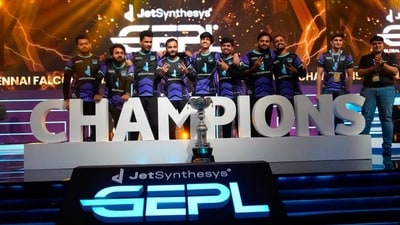
Season 3 of the Global e-Cricket Premier League wrapped up in Pune on Sunday, August 9, with eight franchises, up from six last year; a record ₹3.1 crore prize pool; and a broadcast deal that took the tournament to American and Canadian television for the first time. Two seasons ago, GEPL was played in front of a single stadium's worth of fans. Now, it has exploded beyond the subcontinent, and I spent the weekend at the Jairaj Sports and Convention Centre in Pune talking to the people behind that virality — franchise owners, players, and the board of JetSynthesys, the entertainment and tech company that built the league around the mobile title Real Cricket.
Real Cricket matches in the GEPL are not T20 or even T10 ties; they consist of five-over innings with five wickets per side. It’s short, it’s exciting, and there’s a real jeopardy attached to every four, six, and dismissal. Importantly, the entire contest is wrapped up in under half an hour, and that timeframe is likely one of the major factors behind the boom in the viewership numbers. Traditional cricket asks for a massive time commitment. A single T20 innings takes nearly two hours, while Test matches span five full days, creating a natural barrier for casual viewers. GEPL has shifted the broadcast equation entirely. Instead of competing with marathon sports coverage, it occupies a category closer to a sitcom episode — a viewer can watch a full match during a study break or lunch hour, enjoying a complete sporting narrative without derailing their daily routine.
With more than 500 million gamers, India is one of the fastest-growing markets worldwide for e-sports athletes. Add to that the popularity of Real Cricket, which boasts more than 400 million lifetime downloads, and it becomes clear how GEPL amassed 174 million impressions across its broadcasting deals last season. Mandira Bedi, the actor and cricket presenter who's followed GEPL since its early days and was the guest of honour at the closing ceremony on Sunday, summed it up neatly: “It’s got a very bright future… if it’s not the future already.”
Building a feeder systemWhat’s more interesting is how JetSynthesys wants to build between now and Season 4. Jogesh Lulla, the company's senior vice president for sports, described the plan as a Ranji Trophy for e-cricket — smaller, localised inter-college tournaments that funnel talent up into the professional league, the way domestic first-class cricket feeds the Indian team. I asked him at the press conference whether that expansion was something planned as a build-up to Season 4, or something round the year, and his reaction was coy: “You'll see, it's coming soon. It's all in the works.”
When drawn further, he revealed, “We want to go national, so it's a big plan that's being made now. It's not about one or two colleges here. We want this to be an entire all-India league. So we'll decide how we start, but that's the goal."
Right now, GEPL's pipeline runs through an open registration qualifier bracket that narrows lakhs of hopeful registrants down to the roughly 100 players who go into the auction, where 64 are snapped up to form the eight franchises of eight players each. An inter-college circuit would sit underneath that, catching players earlier — and, Lulla hopes, chip away at a gerontocratic resistance that is still common. “There's so much resistance from parents even today in India on wanting to let their children become e-sports athletes because they think they're playing video games… but more and more athletes now see this as a future for themselves.”
Also Read - HT at Esports World Cup 2026: Doors open for cricket, but ‘easy gold medal’ for India not enough incentive
Girish Menon, JetSynthesys’ chief strategy officer, framed it as a solution to a problem of depth. A sport can survive and thrive only once its talent pool is wide enough that no single publisher or city carries it alone. "If you have only a handful of players, you know it's not going to survive. But if you've got the whole country playing it, that's when the game becomes long-term and sustainable," he said.
Season 3 of the GEPL showed the growth and potential of the Indian e-sports economy, with more teams, more prize money, more reach, and players who could point to their own careers as proof that the pipeline works. More than half of the Season 3 roster came from Tier 2 and 3 cities, including 22 first-time participants — something that company chairman Rajan Navani admitted had far exceeded even his own ambitious wishes when he inaugurated his brainchild in 2023. “It's completely pan-India, completely bottom-up. All you need is a mobile phone and the Internet.”
The auction that filled those 64 slots was the most competitive the league has run. Teams spent ₹62.75 lakh of a combined ₹64 lakh purse, a 98% utilisation rate, and four of the five most expensive players switched franchises rather than being retained. All-rounder Jetha Ram went to the Sara Tendulkar-owned Mumbai Grizzlies for ₹3.5 lakh, the highest fee in GEPL's three seasons. The size of that price tag was not lost on him — “Everyone was saying that we had taken this player for 3.5 lakh rupees. What's he going to do? He can't do much on his own,” he tells me — but he justified it in some style, finishing the tournament as leading run-scorer with 488 runs and winning the MVP award despite losing in the final.
Meanwhile, Chennai Falcons captain Sukhpreet Singh, who'd just led his side to a second straight title, was quick to thank his owners, who gave him great freedom to craft a squad to defend their Season 2 crown.
“After last time's GEPL, some really good esports players also came into e-cricket… My owners gave me a free hand in the auction to choose the team based on my experience. We had a budget, and within that I picked the best possible team.” Ratikanta Sahoo, Gaurav Biswas and Yash Raj Singh—three of Chennai’s champions from last year—were all re-acquired alongside fresh faces. “The ones I trusted—whether new players, experienced players, old players—everyone did their job really well. This wasn’t just a one-man show. It was the whole team’s contribution.”
But that approach, Sukhpreet admitted, was not sustainable. “Building a new team every time is very difficult. With only one captain retention allowed, we had to pick all new players.” He compared it to the IPL, where the core stays the same through a Mega-Auction every three or four years, and the team is refreshed around that in every annual auction. “So if I can suggest any rule changes for the GEPL, it would be that at least a minimum of two or three key players should be retained, so the core remains and the team's faces can be established.”
GEPL added two new franchises this year (Sonu Nigam's Kolkata Hawks and e-sports streamer Tanmay “Scout” Singh's Gujarat Wolves), and there is a desire to expand further. But Navani dismissed speculation over a potential partnership with the BCCI to bring IPL franchises into the GEPL — similar to how the e-Premier League operates in the United Kingdom, with e-sport athletes representing real-world Premier League clubs like Manchester United, Liverpool and Arsenal.
“When starting out, we wanted these guys [e-sport athletes] to have their own fans. We know that makes it even more difficult, but that's what we are aspiring to build… Bengaluru Badgers will have a fan community of a very different kind compared to the IPL team. That’s why we intentionally chose not to sell to any of the [IPL] team owners.”
Badgers owner Prashanth Prakash summed it up: “The whole idea is to create something that is not an extension but an adjacent opportunity.”
That opportunity is yet to bridge the gender gap, with no female player making it to the final 64 roster across the past three seasons. JetSynthesys is proud of the open, anyone-can-qualify pipeline of the GEPL, but that system can only be truly fair if women are actually entering the funnel in meaningful numbers and qualifying for the main auction on merit. Right now, they’re not, but Lulla flagged a game-development complication specific to the format of the e-sport — specifically, the modelling and rendering of the in-game player avatars.
Real Cricket recreates an athlete's real appearance, fitness, batting and bowling action in the game. “Cricket has a distinction between male and female leagues, as the physicality of the game is very different. So the physics of the game for females needs to reflect that, right? Should this be one game for all, or two separate sports? That's what we’re looking to solve.”
The participation of female players, thus, is not a simple toggle, nor a level playing field. It will need a robust talent pool like the men’s. Prakash drew a comparison to the time it took for the WPL to follow the IPL, and Lulla elaborated: “We can only do it when we have a sizeable community. And first, we have to actually build that community of female gamers in real cricket itself. Otherwise, there's no point in doing this. Give it time.”
Navani has bigger ambitions still. He wants GEPL to be uttered in the same breath as the IPL and the Premier League. Beyond that, he sees India winning e-sports medals at future Olympic Games, and being at the forefront of the global e-sports boom in the coming decades. For now, that remains wishful thinking — the International Olympic Committee's planned 2027 e-Games in Saudi Arabia stands voided after its partnership with the Saudi Arabian Olympic Committee and the E-Sports World Cup Foundation ended last October, and the Olympics E-Sports Commission was disbanded in May this year. But none of that is stopping him from dreaming.
| # | Наименование новости | Тональность | Информативность | Дата публикации |
|---|---|---|---|---|
| 1 | The beauty category’s big transformation | 0 | 8.4 | 17-05-2026 |
| 2 | We’re increasingly acting as consultants rather than just advertisers: Innocean COO | 0 | 8.57 | 14-06-2026 |
| 3 | Del folio a la plataforma: Cuánto tiempo se necesita para sacar adelante una serie de televisión | 0 | 7 | 16-05-2026 |
| 4 | Del folio a la plataforma: Cuánto tiempo se necesita para sacar adelante una serie de televisión | 0 | 5 | 16-05-2026 |
| 5 | Del folio a la plataforma: Cuánto tiempo se necesita para sacar adelante una serie de televisión | 0 | 6 | 16-05-2026 |
| 6 | Sports leagues find that streaming pirates have their purposes | 0 | 5 | 23-10-2025 |
| 7 | Исследование: россияне в самоизоляции стали больше смотреть телевизор | 0 | 0 | 31-03-2020 |
| 8 | Pakistan’s Crypto Gambit | -2 | 6 | 24-02-2026 |
| 9 | Welcome to the age of the vodcast | 5 | 7 | 08-01-2026 |