Просмотр новости
Найдите то, что Вас интересует
 Спутники
 РН
РН SpaceX
 Роскосмос
 NASA
NASA
СпутникиРНSpaceXРоскосмосNASAShankar Abaji Bhise, remembered by R Madhavan in an AI-generated Instagram video, was a self-taught Indian inventor once called the “Edison of India”. Despite having only a high school education, he reportedly created more than 200 inventions. Inspired by Scientific American, he developed gadgets, weighing machines and electronic signboards. His Bhisotype typecaster aimed to transform printing. Dadabhai Naoroji, Gopal Krishna Gokhale and Henry Hyndman supported his inventive work.
Synopsis
Shankar Abaji Bhise, remembered by R Madhavan in an AI-generated Instagram video, was a self-taught Indian inventor once called the “Edison of India”. Despite having only a high school education, he reportedly created more than 200 inventions. Inspired by Scientific American, he developed gadgets, weighing machines and electronic signboards. His Bhisotype typecaster aimed to transform printing. Dadabhai Naoroji, Gopal Krishna Gokhale and Henry Hyndman supported his inventive work.
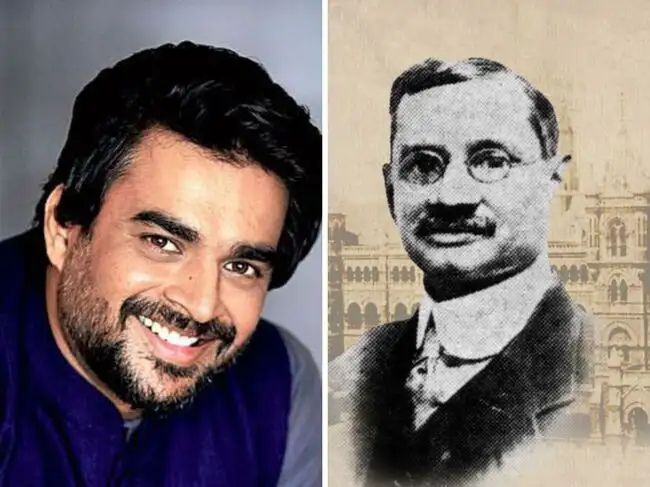 Madhavan shared a video of Shankar Abaji Bhise, who only had a high school education but developed a lifelong passion for science and experimentation. (Agencies/@@MinOfCultureGoI)
What if formal education had never been the limit to invention? Actor R Madhavan recently highlighted the remarkable story of Shankar Abaji Bhise, the self-taught Indian inventor once described as the “Edison of India”. In an AI-generated video shared by Madhavan, Bhise introduces himself as an inventor who created more than 200 inventions despite having only a high school education. His journey from reading scientific magazines in colonial Bombay to developing machines for printing and commerce remains a remarkable chapter in India’s history of innovation.
R Madhavan remembers Shankar Abaji BhiseActor R Madhavan recently took to Instagram to share an AI-generated video dedicated to Shankar Abaji Bhise. The video presents Bhise narrating his own extraordinary journey, beginning with the claim that he created more than 200 inventions and was known as the “Edison of India”.
The video also highlights how Bhise had only a high school education but developed a lifelong passion for science and experimentation. He recalled reading scientific magazines from a young age and experimenting with different ideas. One of the early moments that brought him recognition came when he won 10 pounds in England for inventing an automatic weighing machine.
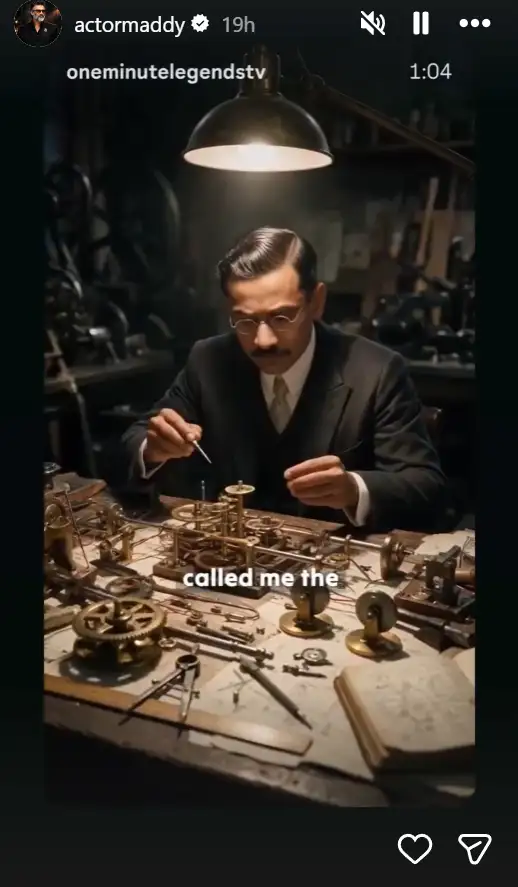
Screenshot of the IG Story
Shankar Abaji Bhise was a self-taught Indian inventor whose work spanned numerous fields. On April 7, the Minister of Culture of the Government of India took to X to remember Bhise, describing him as an inventor who had once been named the “Edison of India” in a US newspaper.
The minister also highlighted Bhise's contribution to science communication. He published a Marathi science magazine called Vivid Prakash, while his influential inventions included the Spasotype and Piezotype. Bhise lived from April 29, 1867, to April 7, 1935, leaving behind a legacy that extended well beyond individual inventions.
According to the BBC, Bhise grew up in the crowded streets of colonial Bombay, now Mumbai, where he spent considerable time reading Scientific American magazines. That early exposure had a profound impact on him. Bhise later told a Brooklyn newspaper that he owed everything to the “mechanical education” he received from the American magazine.
By his early 20s, Bhise had already begun designing a wide range of gadgets and machines. His creations included tamper-proof bottles, electrical bicycle contraptions and a station indicator for Bombay's suburban railway system. His curiosity was not confined to one area. Bhise continued experimenting with ideas that could solve practical problems and improve everyday technology.
The invention that brought Bhise international attentionBhise's breakthrough came in the late 1890s after he discovered a competition launched by a British inventors' journal to design a machine for weighing groceries. His work eventually earned him recognition in England. He also designed an innovative electronic signboard that was exhibited at the Crystal Palace in London. According to the BBC, the invention was later adopted in stores in central London, Wales and possibly Paris.
His ambitions, however, extended far beyond weighing machines and signboards. Bhise reportedly informed Dadabhai Naoroji about an impressive range of inventions, including kitchen gadgets, a telephone, a device intended to cure headaches and an automatically flushing toilet.
Bhisotype: The invention that could transform printingAmong Bhise's many ideas, his most significant invention was arguably the Bhisotype. The mechanical typecaster was designed to transform the printing industry by producing metal type quickly and cheaply. These metal types were essential for printing books and newspapers, according to the BBC. The Bhisotype promised to make the process faster and more efficient than the systems used by leading companies at the time. It was an ambitious invention with the potential to reshape an industry that was central to the spread of information.
Bhise's work on printing technology also demonstrated the breadth of his ambitions. He was not simply experimenting with small household gadgets. He was attempting to develop machines that could have a wider industrial and commercial impact.
Three of his most significant supporters were Dadabhai Naoroji, Gopal Krishna Gokhale and British socialist Henry Hyndman. Their support helped Bhise pursue his inventive work at a time when developing and commercialising new technology required considerable financial resources.