Просмотр новости
Найдите то, что Вас интересует
 Спутники
 РН
РН SpaceX
 Роскосмос
 NASA
NASA
СпутникиРНSpaceXРоскосмосNASAThe post Italian Grammar Ranked EASIEST to HARDEST with Cheat Codes appeared first on The Intrepid Guide
Italian grammar isn’t just a list of rules to memorise. It’s full of patterns, shortcuts, and cheat codes that most…
The post Italian Grammar Ranked EASIEST to HARDEST with Cheat Codes appeared first on The Intrepid Guide.
The Intrepid Guide contains affiliate links. At no cost to you, I will earn a commission which helps reduce the ever-increasing costs of keeping this site active. Thank you for your support.
Italian grammar isn’t just a list of rules to memorise. It’s full of patterns, shortcuts, and cheat codes that most learners are never taught, which is why they end up feeling overwhelmed, stuck, and afraid to speak. So in this guide, I’m ranking every major Italian grammar topic from easiest to hardest, and for each topic, I’ll give you the cheat codes you need to master them so you don’t waste time, get stuck, or give up.
And these rankings aren’t just my opinion. They’re based on what English speakers actually struggle with, backed by years of teaching thousands of real learners.
Keep practising!
Italian Grammar Ranked EASIEST to HARDEST for English Speakers with Cheat Codes
(Free PDF Cheat-Sheet)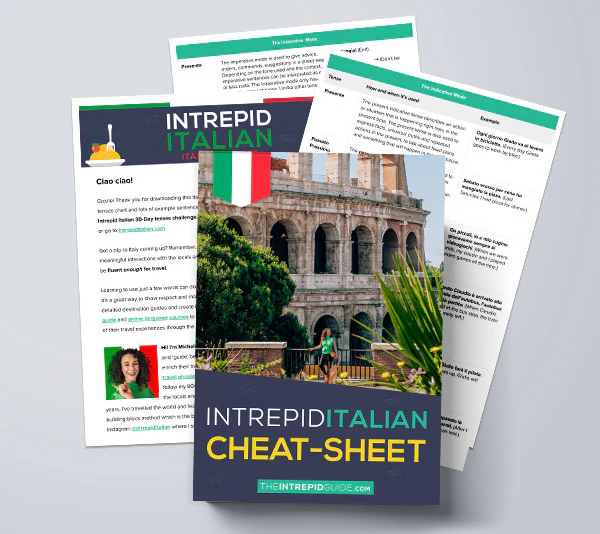
Don't let the learning stop here. Download your free PDF guide on the easiest and hardest parts of Italian grammar. Includes BONUS cheat-codes so you don’t waste time, get stuck, or give up. Impariamo insieme! (Let's learn together!)
I promise not to spam you. You can unsubscribe at any time.
Invalid email address
Here’s how the ranking works:
So with that said, let’s start!
Italian Grammar #1: Cognates Are Surprisingly SimpleThe first part of Italian grammar we’ll look at is so easy that English speakers can start speaking Italian from day one.
It’s a category of Italian words you already know without studying a single one. I’m talking about parole affini, literally related words, or cognates. Italian and English share thousands of words that are nearly identical, thanks to their Latin roots.
Here are just a few:
Notice any patterns? English words ending in -tion become -zione in Italian. English words ending in -ty become -tà in Italian. English words ending in -al become -ale in Italian, and -ible becomes -ibile.
So where do cognates rank? They go in the S tier for Surprisingly simple.
Best cheat code to learn cognates: no matter what your level is, learn as many cognate cheat codes as you can to unlock thousands of Italian words.

I’ve just shared four cheat-codes here, but if you want all 17 cheat codes, make sure you download your free PDF cheat sheet. To get your copy, just enter your details below.
Keep practising!
Italian Grammar Ranked EASIEST to HARDEST for English Speakers with Cheat Codes
(Free PDF Cheat-Sheet)
Don't let the learning stop here. Download your free PDF guide on the easiest and hardest parts of Italian grammar. Includes BONUS cheat-codes so you don’t waste time, get stuck, or give up. Impariamo insieme! (Let's learn together!)
I promise not to spam you. You can unsubscribe at any time.
Invalid email address
The next part is what makes Italian one of the easier languages for English speakers to learn, and there’s no trick to it. You just need a few simple tips.
In English, spelling and pronunciation don’t match. Consider these words: though, through, tough, thought. Same four letters, four different sounds. Italian is much simpler.
I’m talking about Italian pronunciation. Lucky for us, Italian is a phonetic language, which means almost every letter makes the same sound every time. There are only a handful of exceptions to look out for. More on that in a second!
So where does Italian pronunciation rank? It goes in the S tier for Surprisingly simple.
Italian pronunciation is more predictable than English, French, or even Spanish in some cases. You’ll never have to guess how a word is pronounced.
Best cheat code for pronunciation: as I mentioned, there are some exceptions. For example, the letter C in Italian has two sounds, and which one you use depends entirely on the letter that follows it.
When C is followed by E or I, it makes a soft “ch” sound, like the ch in cheese:
But when C is followed by H, O, U, or A, it makes a hard “k” sound, like the c in car:

For more pronunciation cheat codes like these, make sure you download your free PDF cheat sheet. To get your copy, just enter your details below.
Keep practising!
Italian Grammar Ranked EASIEST to HARDEST for English Speakers with Cheat Codes
(Free PDF Cheat-Sheet)
Don't let the learning stop here. Download your free PDF guide on the easiest and hardest parts of Italian grammar. Includes BONUS cheat-codes so you don’t waste time, get stuck, or give up. Impariamo insieme! (Let's learn together!)
I promise not to spam you. You can unsubscribe at any time.
Invalid email address
The next part of Italian grammar gives English speakers an advantage that learners of other languages miss out on. Here’s why.
In many languages, you have to completely relearn how to structure a sentence. German pushes verbs to the end. Japanese flips the whole order around.
I’m talking about Italian sentence structure and word order, which is almost identical to English: subject, verb, then object.
Look at these:
So where does Italian word order rank? It goes in the A tier for Almost effortless.
Of course, there are some important differences from English worth noting, such as adjectives usually going after the noun, for example, la macchina rossa, literally “the car red”. But these are only small shifts to remember, nothing drastically different.
Best cheat code to learn word order: start with English word order as the base, subject, verb, object, then remember to put adjectives after the noun. This becomes more automatic with repetition.

The next part of Italian grammar is a brand-new concept for English speakers, but if you do this one thing, it’ll become second nature.
In Italian, every single noun belongs to one of two groups, and the group it’s in changes the spelling of the other words around it.
I’m talking about Italian grammatical gender. Every Italian noun is either masculine or feminine. But this doesn’t mean the object itself is biologically male or female. It’s simply the way Italian organises nouns.
Most Italian nouns follow these basic ending rules:
Gender doesn’t just affect the noun. It affects everything around it. The article changes, il vs la, the adjective changes, rosso vs rossa, and sometimes the verb too.
And getting the gender right matters more than you’d think. Sometimes, switching one letter completely changes the meaning. For example:
So where does grammatical gender rank? It goes in the B tier for Brain-stretcher.
While it’s a new concept for English speakers, it’s not random. It follows very simple rules.
Best cheat code to learn gender: from day one, never learn a noun by itself. Always learn it with its article. That way, you lock in the gender and the article at the same time. This is especially important for nouns that end with -e.

Are you enjoying this guide? Don’t let the learning stop here. Make sure you download your free PDF cheat-sheet which includes more cheat-codes. To get your copy, just enter your details below.
Keep practising!
Italian Grammar Ranked EASIEST to HARDEST for English Speakers with Cheat Codes
(Free PDF Cheat-Sheet)
Don't let the learning stop here. Download your free PDF guide on the easiest and hardest parts of Italian grammar. Includes BONUS cheat-codes so you don’t waste time, get stuck, or give up. Impariamo insieme! (Let's learn together!)
I promise not to spam you. You can unsubscribe at any time.
Invalid email address
The next part of Italian grammar is another quirk of grammatical gender. It’s something English doesn’t really have, but my cheat code takes all the guesswork out.
In English, we have just two ways to say “a”, a and an, and one way to say “the”. But in Italian, “a” has four different forms, and “the” has seven. That’s eleven different ways to say what English handles with three little words. And you have to pick the right one before you can even start your sentence!
I’m talking about Italian articles, both definite, il, la, lo, l’, i, gli, le, and indefinite, un, una, uno, un’.
Which article you use depends on three things: the gender of the noun, whether it’s singular or plural, and the first letter of the noun:

So where do Italian articles rank? They go in the A tier for Almost effortless.
Even though there are more options than in English, the system is quite logical and predictable, but it does take some getting used to.
Best cheat code to learn articles: here’s a shortcut most beginners aren’t taught. Four Italian word endings tell you the gender automatically. If a word ends in -zione, -sione, -tà, or -tù, it’s always feminine, which means you already know to use la or una in front of it.

The next part of Italian grammar can completely change a sentence’s meaning if you forget one tiny word, but my cheat code makes sure you never do.
In English, we say “I wake up” or “I get dressed.” There’s nothing special about these verbs. In Italian, certain verbs, actions you do to yourself, need an extra two-letter word in front of them, and without it the meaning of the sentence completely changes.
I’m talking about reflexive verbs. The rule is simple: if the doer of the action is also the receiver, you need to add a reflexive pronoun.
Compare these:
That little mi is a reflexive pronoun. Without it, you’re washing something else. With it, you’re washing yourself!
Italians use reflexive verbs constantly for daily routines, emotions, and habits:
So where do reflexive verbs rank? They go in the B tier for Brain-stretcher.
Best cheat codes to learn reflexive verbs: reflexive verbs always end in -si in their full, unconjugated form. This is how they appear in the dictionary: svegliarsi, lavarsi, vestirsi.
To remember all six reflexive pronouns in the right order, mi, ti, si, ci, vi, si, here’s a phrase I give all my students:
Mia’s Tipsy Sister Circles Via Sistina.

Each word stands for one pronoun: Mia’s, Tipsy, Sister, Circles, Via, Sistina. Side note: Via Sistina is a real street in Rome that leads to the Spanish Steps!

The next part of Italian grammar is the first major hurdle for English speakers. But with my memorable cheat code, you’ll get it right every time.
In English, forming the past tense is simple. You just change the verb. I eat becomes I ate, I go becomes I went. In Italian, there are more steps. You have to build the past tense out of two parts: a helper verb, plus the main verb.
I’m talking about compound tenses like passato prossimo, the past tense that Italians use 80% of the time. But there are two things that trip English speakers up.
The first challenge is choosing between two helper verbs: avere (to have) or essere (to be).

Most verbs require avere. But verbs of movement, such as andare, venire, entrare, and uscire, and reflexive verbs all require essere.
The second challenge is gender agreement. When you use essere, the past participle has to agree with the subject, masculine or feminine, singular or plural:
That ending changes based on who’s doing the action.
So where do compound tenses like il passato prossimo rank? They go in the C tier for Complex but conquerable.
Best cheat code to learn the passato prossimo: the hardest part is choosing essere or avere. Since most verbs require avere, just learn the small group of exceptions that use essere.
To do this, picture a house, the House of Essere, where your whole life happens. You’re born, nascere. You arrive home as a baby, arrivare, and people come over, venire. They walk in the door, entrare. Some stay for dinner, restare, rimanere. The house is where you are, essere.
You become an adult, diventare. You stay home, stare, and relax. Or you go out, uscire, leave for a trip, partire, go, andare, and come back home, tornare. You climb the stairs, salire, and come back down, scendere. Until finally, the story ends, morire.

Every verb in this house involves movement or a change of state, and all require essere, along with reflexive verbs. Everything else takes avere.
Italian Grammar #8: Pronouns Are Easier in GroupsThe next part of Italian grammar has more than 30 variations, which can be overwhelming at first, but with my cheat codes they become much easier.
In English, you can talk about he, him, and himself with just three words. In Italian, that same person needs four different words, and that’s just one person. Multiply that across I, you, she, we, they, and you’ve got nearly thirty variations to learn.
I’m talking about Italian pronouns, and there are four groups to learn: subject, direct object, indirect object, and reflexive.
These include:

So where do pronouns rank? They go in the C tier for Complex but conquerable.
Best cheat codes to learn pronouns: the easiest way to remember each group is with my cheat code, a phrase where every word stands for one pronoun. Here’s the one for subject pronouns:
Mario tuned Luigi and Leila’s noisy violin in Loreto.

To get all 4 pronoun cheat codes, make sure you download your free PDF cheat sheet. To get your copy, just enter your details below.
Keep practising!
Italian Grammar Ranked EASIEST to HARDEST for English Speakers with Cheat Codes
(Free PDF Cheat-Sheet)
Don't let the learning stop here. Download your free PDF guide on the easiest and hardest parts of Italian grammar. Includes BONUS cheat-codes so you don’t waste time, get stuck, or give up. Impariamo insieme! (Let's learn together!)
I promise not to spam you. You can unsubscribe at any time.
Invalid email address
The next part of Italian grammar makes even advanced learners hesitate mid-sentence because they follow almost no logic. You’ll definitely need my cheat codes for this.
In English, words like in, at, on, to, and of don’t change form. But in Italian, not only do they merge with definite articles, such as il, lo, gli, i, le, and la, and change form, many can’t be directly translated.

I’m talking about preposizioni, Italian prepositions.
Italian has eight basic prepositions: di, a, da, in, con, su, per, tra/fra.
When prepositions are next to a definite article, most of them merge to form one word. These are called preposizioni articolate, articulated prepositions.
There are 30 of these forms! The bigger challenge is that prepositions don’t always directly translate between English and Italian. For example:
There are some patterns, but plenty of exceptions.
So where do prepositions rank? They go in the C tier for Complex but conquerable.
Best cheat codes to learn prepositions: here is one preposition cheat code you can use.
To remember how to use DI, think of your ID card. It shows where you’re from. Flip the letters of ID and you get DI. So when someone asks Di dove sei?, “Where are you from?”, the answer is Sono di Londra, “I’m from London”.

To get more cheat codes like these, make sure you download your free PDF cheat sheet. To get your copy, just enter your details below.
Keep practising!
Italian Grammar Ranked EASIEST to HARDEST for English Speakers with Cheat Codes
(Free PDF Cheat-Sheet)
Don't let the learning stop here. Download your free PDF guide on the easiest and hardest parts of Italian grammar. Includes BONUS cheat-codes so you don’t waste time, get stuck, or give up. Impariamo insieme! (Let's learn together!)
I promise not to spam you. You can unsubscribe at any time.
Invalid email address
The next part of Italian grammar can be a real nightmare for learners. But if you apply my 80/20 method, I’ll show you the only top 20% you actually need.
In English, we have twelve tenses. Italian has twenty-one!
That’s nine extra tenses, and most of them, you’ll never need to use.
These tenses are:
So where does learning all 21 Italian tenses rank? It goes in the D tier for Difficult.
Some have rough English equivalents that most English speakers haven’t actively used in years. Others are Italian-only constructions you have to learn from scratch.
Best cheat code for the extra tenses: so which of the nine tenses do you actually need? Only three are used 80% of the time:
This comes with one important caveat: only learn these once you’ve mastered the basics, presente, passato prossimo, futuro, condizionale, imperativo, and imperfetto. These three “extras” build directly on those foundations, so trying to learn them first will only confuse you.
Italian Grammar #11: The Congiuntivo Is Difficult but LearnableThe next part of Italian grammar kind of exists in English, making it one of the most confusing, if not feared, topics in Italian, but I’ve got a cheat code that makes it far less scary.
In English, when we express doubts, opinions, wishes, and emotions, that is, anything subjective, we used to use a special verb form. Today, not so much. But Italian still does, and it’s a fundamental part of the language. It’s called a mood and is used for anything non-factual.
I’m talking about the congiuntivo, the Italian subjunctive mood and its four tenses: presente, passato, imperfetto, trapassato.
English has this same mood. We just barely use it anymore. When you say “If I were rich,” that were is the English subjunctive. Same with “It’s important that she be on time” instead of “is on time”; be is the subjunctive too. While English has mostly replaced the subjunctive, it’s still at the heart of Italian grammar.
The Italian subjunctive is triggered by specific verbs and phrases:
Notice how each one starts with che, that. That’s often the trigger.
So where does learning the Italian subjunctive rank? It goes in the D tier for Difficult.
Best cheat codes to learn the congiuntivo: if the concept of the subjunctive feels weird, that’s because it is! Use this WEIRDO cheat code to remember when to use it.
Every letter of WEIRDO represents when you need to use the subjunctive:

The next part of Italian grammar is so hard that even native Italians get it wrong. But without it, you’ll never truly be fluent.
In English, when you report what someone said, the tenses shift in a fairly simple way. “I eat pizza” becomes “He said he ate pizza.” In Italian, you have to match every tense in the original sentence to a corresponding tense in the reported version. And the rules are unforgiving.
I’m talking about la concordanza dei tempi, tense agreement and reported speech.
Here’s the basic concept. If you originally say:
When someone relays what you said to someone else, they have to shift every single tense:
The vado, present, becomes sarebbe andato, past conditional. The domani, tomorrow, becomes il giorno dopo, the next day.
Now multiply this across every tense and every type of sentence, wishes, hypotheticals, statements, questions.
So where does tense agreement rank? It goes at the bottom of the D tier for Difficult because it requires a lot of mental grammar gymnastics.
Best cheat codes to learn the concordanza dei tempi: first, don’t even attempt this until you’ve mastered the subjunctive and the conditional tenses. Trying to learn them together is overwhelming. Second, learn through real examples, not abstract rules.
It’s important to remember that even if you never master this perfectly, you’ll still be understood. Italians don’t expect perfection. They appreciate any effort you make, even if you’re just starting out. So don’t let la concordanza dei tempi be the thing that stops you from speaking.

So here’s the complete ranking of every Italian grammar topic:
Master the S tier first to build confidence. Add the A tier to lock in the basics. Take your time with B and C because these are where real fluency begins. And don’t stress about D, even native Italians struggle with the hardest stuff.

Even though you now know which parts of Italian grammar are the easiest and hardest to learn, none of it matters if you can’t actually form a proper sentence. So get my guide o where I share the only 3 Italian verbs you need to say anything in Italian.
 Are you a beginner or an intermediate Italian learner? Got a trip coming up or want to communicate with your Italian partner or relatives in Italian? Learn Italian with my unique 80/20 method
Registrations are now open to join Intrepid Italian, my new series of online video courses that use my unique 80/20 method. You’ll go from a shy, confused beginner to a proficient and confident intermediate speaker, with me as your trusty guide.
You’ll finally be able to connect with your Italian partner, speak to your relatives and enjoy authentic travel experiences in Italy that you’ve always dreamed of, and so much more.
As a native English speaker who learned Italian as an adult, I know what it’s like to feel hopeless and lack the confidence to speak. I know what it’s like to start from scratch and to even go back to absolute basics and learn what a verb is!
Intrepid Italian was created with YOU in mind. I use my working knowledge of the English language to help you get into the ‘Italian mindset’ so you can avoid the common pitfalls and errors English speakers make – because I made them once too! I break everything down in such a way that it ‘clicks’ and just makes sense.
No matter what your level is, there is an Intrepid Italian course for you, including:
You can join 1, 2, 3 or all 4 courses, it’s entirely up to you. The best part is that you have lifetime access so you learn anytime, anywhere and on any device.
As your guide, I walk you through each lesson, step-by-step, using my unique 80/20 method. My approach is different from traditional methods because I teach you the most important 20% of the language right from the beginning so you can start to speak straight away.
Each course includes video lessons, audio exercises, downloadable worksheets, bonus guides, a private support community, and lifetime access all designed to streamline your learning while having fun.
It even comes with my famous “Celebrate with a Spritz Guarantee”. After 30 days of using Intrepid Italian, if you don’t want to celebrate your new-found Italian skills with an Aperol Spritz, you don’t have to pay a penny! Cheers! 🥂 Join Intrepid Italian here and start learning today! Ci vediamo lì! (chee veh-DYAH-moh lee) (See you there!)
Like it? Pin it for later!

Did you enjoy this lesson? Do you have a question? Let me know using the comments section below or join me on social media @intrepidguide or @intrepiditalian to start a conversation.
Thanks for reading and I hope you enjoyed this post.
Like what you see? Subscribe using the form below to have all of my posts delivered directly to your email.
| # | Наименование новости | Тональность | Информативность | Дата публикации |
|---|---|---|---|---|
| 1 | How to Learn Italian EVEN IF You Don’t Have Time | 0 | 7.23 | 24-04-2026 |
| 2 | How to Learn Italian Words in Seconds with 5 Shortcuts | 0 | 7.05 | 24-04-2026 |
| 3 | 7 HIDDEN Shortcuts to Conjugate Italian Verbs in ANY Tense | 0 | 5.63 | 26-05-2026 |
| 4 | 4 Cheat Codes to Master Italian Personal Pronouns (Complete Guide) | 0 | 5.2 | 26-05-2026 |
| 5 | Italian Tenses Ranked: Which Ones You ACTUALLY Need to Learn First | 0 | 4.81 | 26-05-2026 |
| 6 | 5 NEW Italian Movies on Netflix in 2026 to Learn Italian (For Beginners) | 0 | 5.6 | 07-07-2026 |
| 7 | 5 NEW Italian Shows on Netflix in 2026 to Learn Italian (For Beginners) | 0 | 6.17 | 07-07-2026 |
| 8 | If Your Italian ISN’T Improving…Do This! (4 Simple Changes) | 0 | 9.21 | 24-04-2026 |
| 9 | 5 NEW Italian Shows on Netflix in 2026 for A2–C2 Learners | 0 | 7.93 | 07-07-2026 |
| 10 | Rome named Europe's worst place for bed bug complaints and dirty mattresses - where does your favourite holiday destination rank? | 0 | 9.49 | 16-06-2026 |