Просмотр новости
Найдите то, что Вас интересует
 Спутники
 РН
РН SpaceX
 Роскосмос
 NASA
NASA
СпутникиРНSpaceXРоскосмосNASAAn international study led by Rodolfo Christiansen (GFZ Potsdam) and involving Guido Gianni, a senior researcher at the Institute of Geophysics of the CAS, has for the first time realistically quantified natural hydrogen (H₂) generation rates during serpentinization of mantle rocks. The results, published in Nature Communications (2026), show that this process is slower than previously thought, and that […]
The post Researchers of the Institute of Geophysics help quantify natural hydrogen generation in mantle rocks appeared first on Domů.
An international study led by Rodolfo Christiansen (GFZ Potsdam) and involving Guido Gianni, a senior researcher at the Institute of Geophysics of the CAS, has for the first time realistically quantified natural hydrogen (H₂) generation rates during serpentinization of mantle rocks. The results, published in Nature Communications (2026), show that this process is slower than previously thought, and that large, economically viable accumulations would require timescales of thousands to tens of thousands of years.
Main findings
H₂ generation rates in two contrasting geological settings (Western Pyrenees and Northern California) are on the order of 0.1 to 0.5 tonnes of H₂ per year per cubic kilometre of reactive rock, equivalent to 300–600 tonnes per year per entire system.
The limiting factor is not only rock chemistry, but also hydrogen saturation in the fluid and reaction kinetics. In most cases, the available water quickly becomes saturated with H₂, stopping the reaction until the fluid is renewed.
The study integrates for the first time 3D geophysical inversion (gravity and magnetics), thermal modelling, and fluid‑rock process simulation with kinetic and solubility constraints.
The team developed a quasi‑dynamic modelling framework (open‑source code PoNHy) that combines:
The work provides a quantitative basis for assessing natural hydrogen as a low‑carbon energy resource. It shows that, although significant emissions exist (e.g., in ophiolites from Albania or the Philippines), rapid large‑scale replenishment is unlikely. Thus, exploitable accumulations would require exceptional trap and seal conditions.
Code and data are openly available:
Full reference:
Christiansen, R., Sobh, M., Ostertag‑Henning, C., Gianni, G., Sasitpury, N., Chevrot, S., Langenheim, V., Garcia‑Pintado, J. & Gabriel, G. (2026). Controls on natural hydrogen generation during serpentinization of mantle rocks. Nature Communications, 17, 5211. https://doi.org/10.1038/s41467-026-73920-5
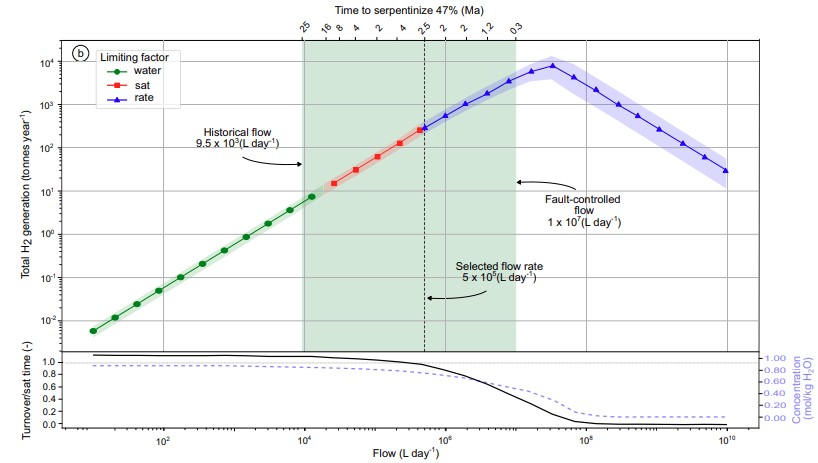
Figure | Hydrogen production vs. water inflow.
Annual H₂ generation (tonnes/year) as a function of daily water flow through the serpentinizing system. Colours indicate the dominant limiting factor: green = water‑limited (too little fluid), red = H₂ saturation‑limited (fluid saturates quickly, stopping further reaction), blue = kinetics‑limited (reaction rate is the bottleneck). The plateau at intermediate to high flow rates shows that once saturation or kinetics takes over, adding more water does not increase H₂ production. This explains why natural hydrogen generation remains modest even in water‑rich settings.