Просмотр новости
Найдите то, что Вас интересует
 Спутники
 РН
РН SpaceX
 Роскосмос
 NASA
NASA
СпутникиРНSpaceXРоскосмосNASAAround four-in-ten Republicans (38%) say the U.S. benefits at least a fair amount from being part of NATO – down from 49% last year. Among Democrats, 82% say this.
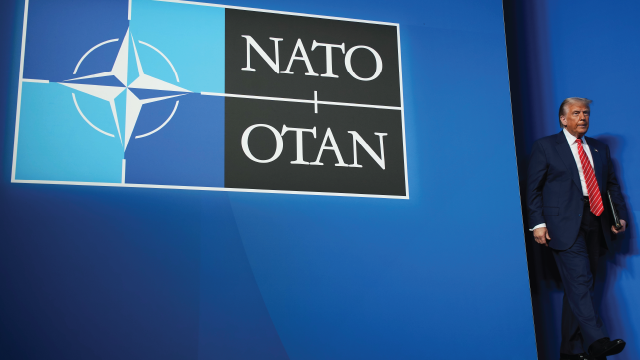 President Donald Trump arrives to speak to the press following the NATO summit on June 25, 2025, in the Netherlands. (Andrew Harnik/Getty Images)
Republicans have become considerably less likely to say the United States benefits from being a member of NATO, according to a new Pew Research Center survey.
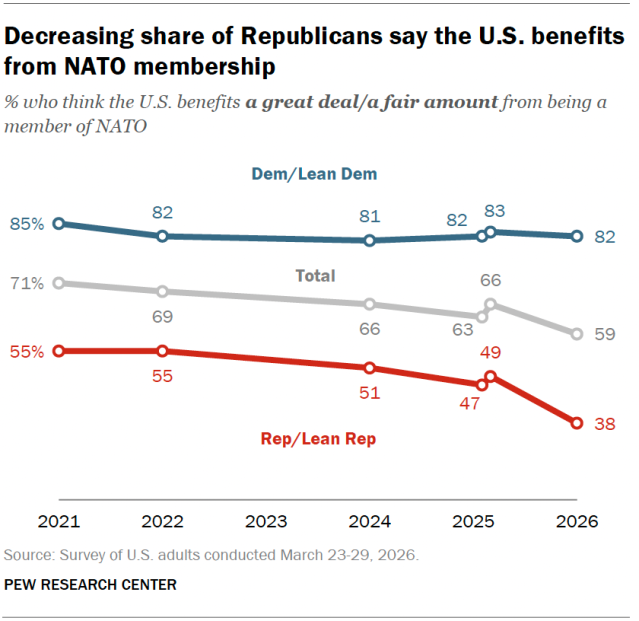
Around four-in-ten Republicans and GOP-leaning independents (38%) say the U.S. benefits a great deal or a fair amount from being part of NATO – down from 49% last year. A majority of Republicans (60%) now say the U.S. benefits not too much or not at all from being part of the alliance, up from 50% in 2025. This marks the first time in our surveys that a majority of Republicans have expressed this view.
The survey was fielded in late March, shortly before President Donald Trump said he was strongly considering withdrawing the U.S. from the military alliance in an interview published April 1.
Overall, a majority of Americans (59%) continue to say the U.S. benefits from being a member of NATO. That’s especially the case among Democrats and Democratic-leaning independents, 82% of whom see benefits for the U.S. Democratic opinion on this question has stayed relatively stable over the past five years.
Democrats’ views about NATO membership do not differ by age, but there are age divisions among Republicans. Younger Republicans – those ages 18 to 49 – are more likely than those 50 or older to say the U.S. benefits from being part of the alliance (42% vs. 33%).
About this researchThis Pew Research Center analysis examines Americans’ attitudes about NATO.
Why did we do this?Pew Research Center does research to help the public, media and decision-makers understand important topics. This analysis builds on our previous work examining Americans’ views of NATO.
Learn more about Pew Research Center.
How did we do this?For this analysis, we surveyed 3,507 U.S. adults from March 23 to 29, 2026. Everyone who took part in the survey is a member of the Center’s American Trends Panel. The survey represents the views of the full U.S. adult population.
Here are the survey questions used for this analysis, the detailed responses and the survey methodology.
How Americans view Trump’s decision-making on NATOThe survey also finds that most Americans (63%) are not confident that Trump can make good decisions when it comes to working effectively with NATO.
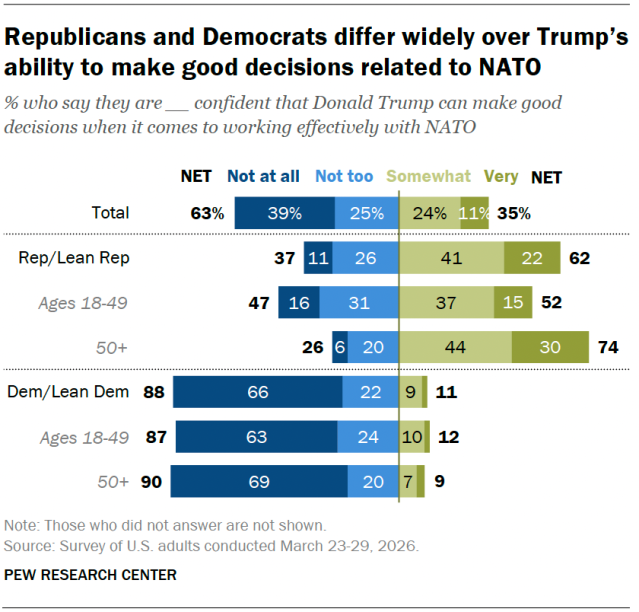
Republicans are significantly more likely than Democrats to be very or somewhat confident that Trump can make good decisions when it comes to working effectively with NATO. Roughly six-in-ten Republicans (62%) say this, compared with 11% of Democrats. Among Democrats, around two-thirds say they are not at all confident in Trump’s ability to work effectively with the alliance.
Among Republicans, views on this question again vary by age:
Within both partisan groups, views also differ by ideology:
When it comes to NATO itself, a majority of Americans (57%) have a favorable view. This figure has remained relatively consistent over the past year, among Republicans and Democrats alike.
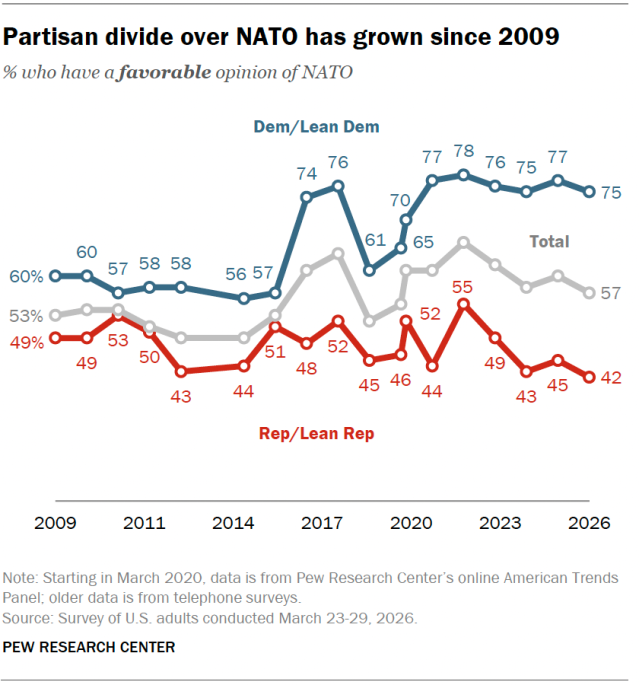
Still, Republicans are much less likely than Democrats to express a favorable view of the alliance (42% vs. 75%). This is a consistent pattern we have observed in previous surveys.
Republicans and Democrats both differ somewhat by age in their views of NATO: Republicans ages 18 to 49 are more likely than their older counterparts to express a positive view (49% vs. 34%). By contrast, older Democrats are more likely than younger ones to have a favorable opinion (80% vs. 71%).
While favorable views of NATO have not shifted much in the U.S. over the past year, they have changed over the longer term. Americans are less likely to see the alliance favorably today than in April 2022, not long after Russia’s military invasion of Ukraine.
Note: Here are the survey questions used for this analysis, the detailed responses and the survey methodology.

Moira Fagan is a senior researcher focusing on global attitudes research at Pew Research Center.

Sneha Gubbala is a research analyst focusing on global attitudes research at Pew Research Center.
| # | Наименование новости | Тональность | Информативность | Дата публикации |
|---|---|---|---|---|
| 1 | Majority of Americans take a dim view of increased trade with other countries | 0 | 6.39 | 29-07-2024 |
| 2 | НАТО трясет после конфликта с РФ: альянс приближается к краху | -3 | 6 | 09-07-2026 |
| 3 | Americans Have Become Less Confident in Trump’s Decision-Making on Ukraine | 0 | 9.76 | 23-04-2026 |
| 4 | Americans say keeping up with key news topics is crucial. But fewer say they’re highly informed themselves | 0 | 8.4 | 05-06-2026 |
| 5 | В США заявили, что Трамп теперь видит ценность НАТО и наличия союзников | 0 | 0 | 10-09-2020 |
| 6 | Do Americans Think the Country Is Losing or Gaining Ground in Science? | 0 | 6.49 | 15-01-2026 |
| 7 | "Никакой выгоды": Трамп вновь жестко высказался о НАТО | -5 | 3 | 02-07-2026 |
| 8 | Трамп: США несут крупнейшие расходы на НАТО без всякой выгоды | 0 | 5 | 02-07-2026 |
| 9 | Опрос: лишь 20% американцев считают Украину союзником США | 0 | 0 | 08-02-2022 |
| 10 | As the 2026 Midterms Approach, Economy Is Front and Center | 0 | 16.2 | 23-07-2026 |