Просмотр новости
Найдите то, что Вас интересует
 Спутники
 РН
РН SpaceX
 Роскосмос
 NASA
NASA
СпутникиРНSpaceXРоскосмосNASAA simple guide for newsrooms that want to map local help, volunteer opportunities and stories of kindness.
The Mirror Indy Kindness Map includes places where Indianapolis residents can receive help, give back or learn about a local act of kindness.
A simple guide for newsrooms that want to map local help, volunteer opportunities and stories of kindness
What does kindness look like in a city?
It may be a free food pantry, a clothing closet or a library where people can use computers and Wi-Fi. It can be an animal shelter looking for volunteers, a neighborhood cleanup or a community garden. And sometimes it is simply a story, when a group of neighbors clean up their block together, someone created a free pet-food pantry for their block or volunteers packed thousands of care kits.
We wanted to put all of these things in one place.
That is how we started building the Mirror Indy Kindness Map, an interactive map of Indianapolis where people can find help, give help and share stories of kindness.
The original idea was inspired by projects like Queering the Map, which invited people around the world to pin personal stories and memories to specific locations. We were also interested in other kindness maps, but we wanted something local and useful for Indianapolis.
Our goal was not only to make a list of nonprofit organizations. We wanted the map to feel practical, personal and connected to different neighborhoods.
We also wanted readers to help build it with us.
Here is the process we used.
First, decide what belongs on the map. For our project, we created three categories:
Simple categories make the map easier to understand.
1. Choose a map platformWe used Proxi, an online tool for building interactive maps.
It allowed us to:
We did not need to code the map. Proxi allowed us to build the map without creating a custom tool from scratch.
2. Make the map fit your newsroomWe added the Mirror Indy logo, brand colors and a simple description.
We also gave each category its own icon:
The icons make the map easy to understand on both desktop and mobile.
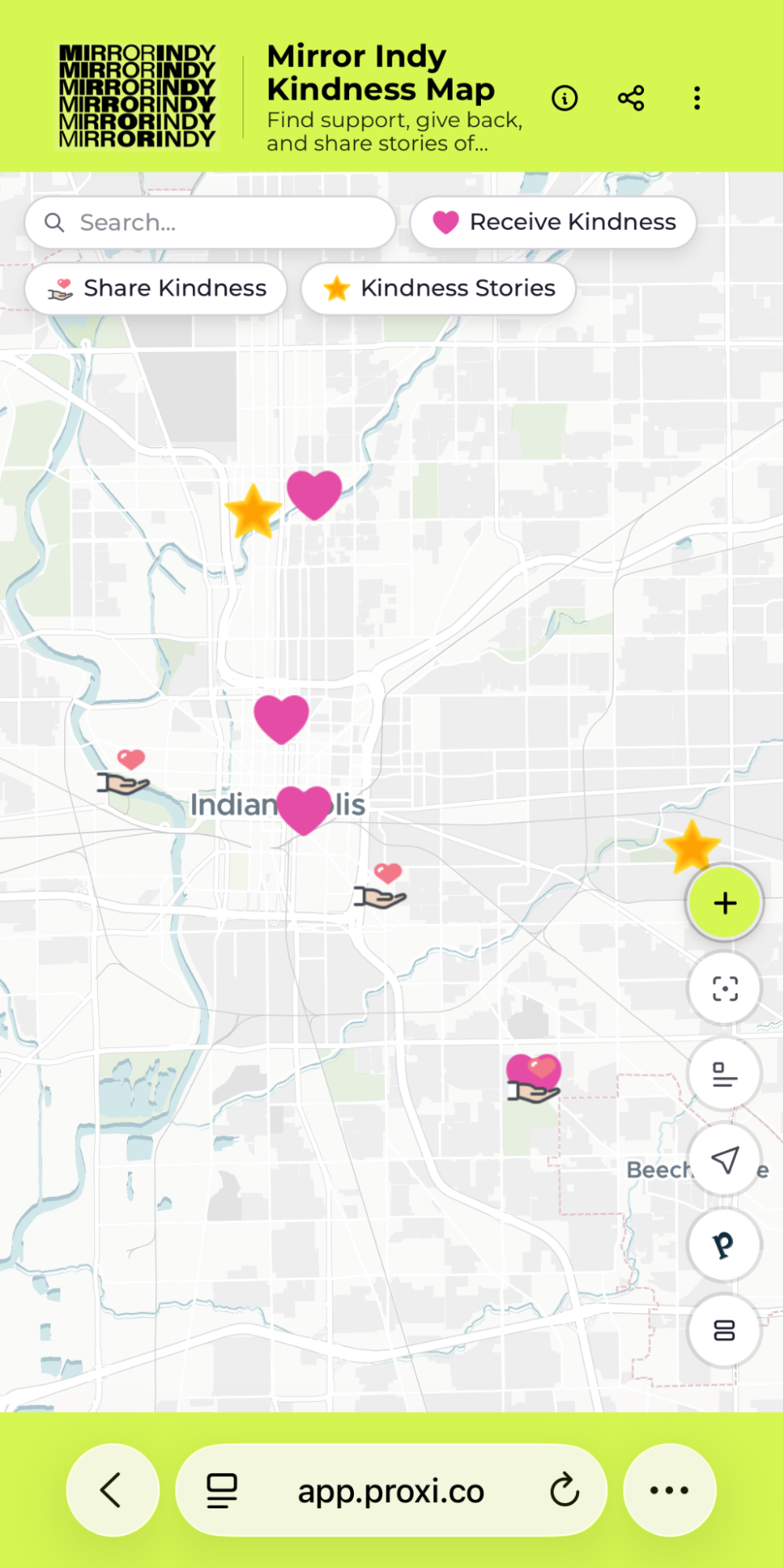 The icons help readers quickly understand the different types of locations.
An empty map is hard to understand, so we added 15 verified locations and stories before sharing it with readers.
The points included:
Each point included:
Newsrooms do not need hundreds of points to begin. Around 10 to 15 strong examples can be enough for a useful prototype before asking for contributions.
4. Upload places in bulkInstead of adding every place one by one, we created a spreadsheet with the names, addresses, categories, descriptions and links. We uploaded the spreadsheet into Proxi and matched each column to the correct map field.
After the upload, we checked the addresses and corrected a few locations manually. This was much faster than creating every point separately.
5. Create simple point cardsWhen readers click a marker, they see a short card.
We kept each card simple:
Descriptions should be short, clear and easy to read on a phone.
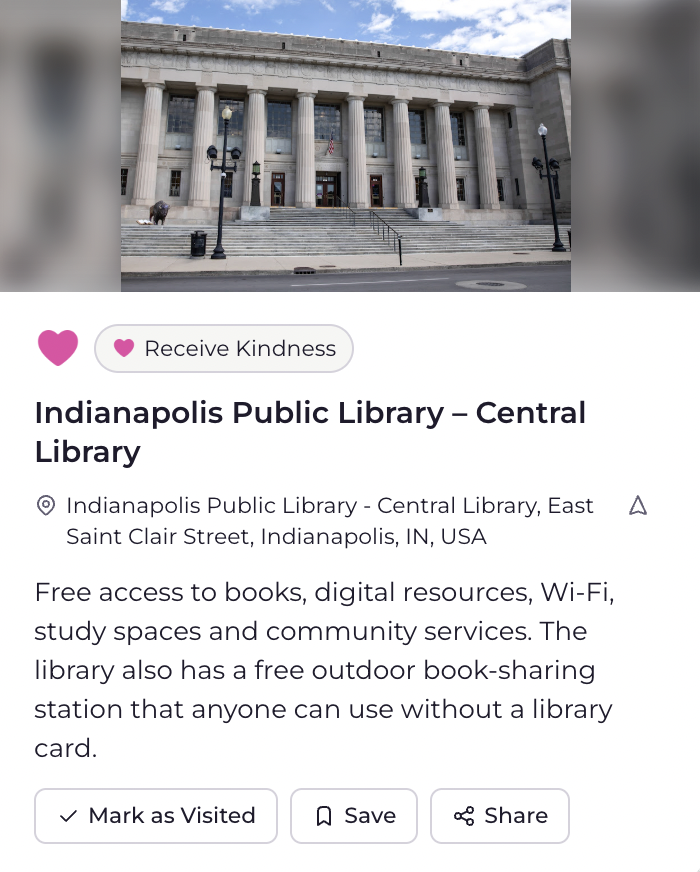
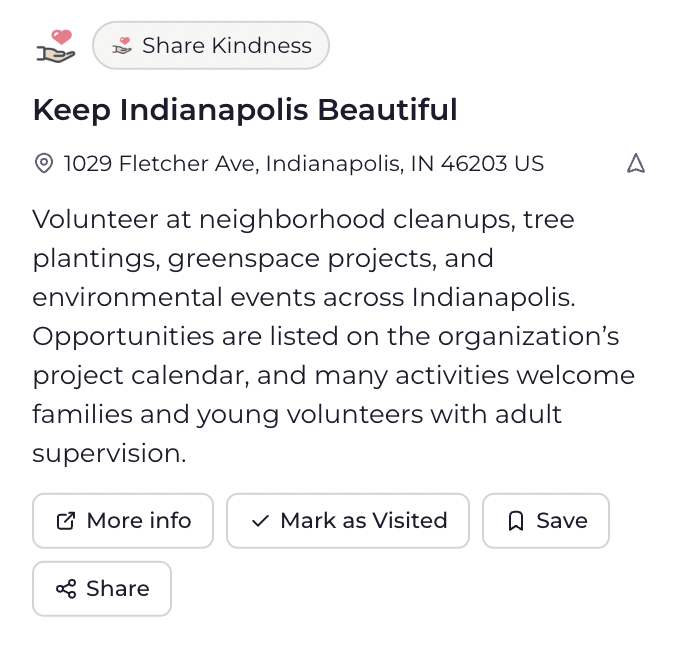
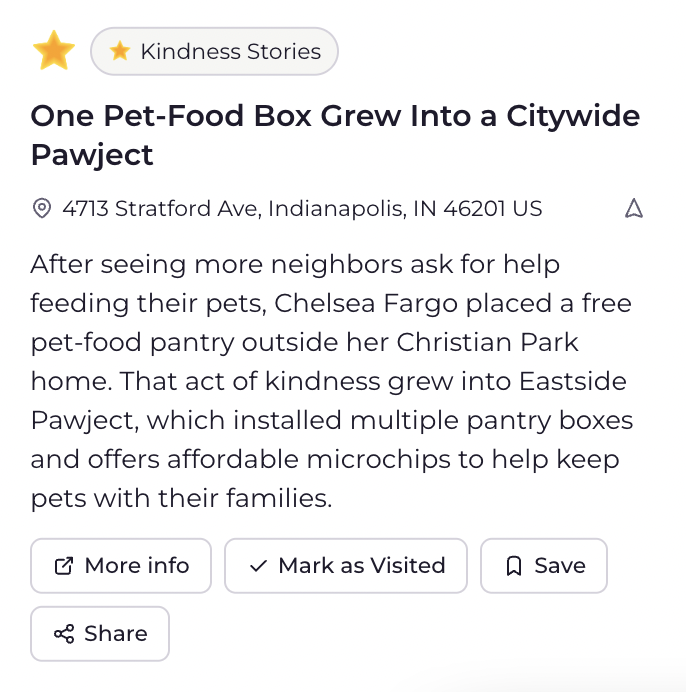 Each card explains why the location is useful and where readers can find more information.
We created a public form called: Add Kindness to the Map
Readers can submit:
We also asked for contact information in case Mirror Indy needs to verify any information.
Readers can suggest new resources, volunteer opportunities and kindness stories.
7. Review submissions before publishingWe turned on Proxi’s approval setting. This means reader submissions do not appear on the map automatically.
Someone in the newsroom can first:
This helps protect privacy and keeps the map accurate.
8. Test the map on desktop and mobileBefore sharing the map, we tested:
The mobile version is especially important because many readers will open the map from social media or a newsletter.
9. Share or embed the mapProxi also creates an embed code. A web editor can paste that code into a Custom HTML or Embed block on the newsroom’s website. A newsroom can share the public Proxi link in:
After the map is embedded, any approved new points will automatically appear wherever it is embeded.
What we learnedThe technical part was not the hardest part. Proxi made it possible to build a map without coding.
The more difficult work was editorial:
We also learned that kindness does not always look dramatic. It can be a library, a free box of food, a volunteer shift or a public space where people feel welcome. A local news organization already reports on many of these places and people. An interactive map gives that reporting another avenue to reach people and let your community participate.
The map can become a guide, a story archive and a community project at the same time. The most important thing is to start small, a newsroom does not need 100 points on the first day. A clear structure, 10 to 15 verified locations and a safe submission process are enough to launch a Kindness Map.
Then the community can help the map grow!
Orlova, Elizaveta (2026, Aug. 11). How to build a kindness map for your community. Reynolds Journalism Institute. Retrieved from: https://rjionline.org/news/how-to-build-a-kindness-map-for-your-community/
| # | Наименование новости | Тональность | Информативность | Дата публикации |
|---|---|---|---|---|
| 1 | How newsrooms collaborating helps their local communities | 0 | 8.1 | 30-07-2026 |
| 2 | Building a civic information hub | 0 | 7.66 | 17-08-2026 |
| 3 | Special event makes finding help easier for older adults | 0 | 8.46 | 05-08-2026 |
| 4 | Why Community Matters in Women’s Heart Health (and How to Find It) | 0 | 10 | 09-07-2026 |
| 5 | Testing Google Ads Grant program to grow local audiences | 0 | 10 | 12-08-2026 |
| 6 | Nonprofit partners with libraries to hold collection for kids in need | 0 | 6.85 | 30-07-2026 |
| 7 | The changing face of loyalty and rewards | 0 | 7.46 | 08-03-2026 |
| 8 | В России создали ягодную карту страны | 0 | 5 | 09-07-2026 |
| 9 | Access all areas: Arts body puts focus on inclusion by bringing Fleadh into care homes and hospices | 0 | 10 | 02-08-2026 |
| 10 | Checks and Balance newsletter: What American democracy looks like up close | 0 | 7 | 31-01-2026 |