Просмотр новости
Найдите то, что Вас интересует
 Спутники
 РН
РН SpaceX
 Роскосмос
 NASA
NASA
СпутникиРНSpaceXРоскосмосNASAIndia is on a path to significantly increase its renewable energy capabilities, targeting 500 GW by 2030. With government incentives fostering polysilicon manufacturing, the nation looks to enhance its position as a top solar module producer while expanding its cell production.
Synopsis
India is on a path to significantly increase its renewable energy capabilities, targeting 500 GW by 2030. With government incentives fostering polysilicon manufacturing, the nation looks to enhance its position as a top solar module producer while expanding its cell production.
Listen to this article in summarized format
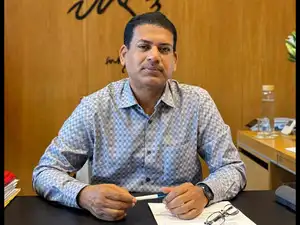 ET OnlineSantosh Kumar Sarangi, Secretary, Ministry of New and Renewable Energy.
New Delhi: The Renewable Energy Ministry is mulling an incentive scheme to boost polysilicon manufacturing in the country to reduce dependence on imports, especially from China.
Speaking at the 7th CII International Energy Conference & Exhibition here in the capital, Union New and Renewable Energy Secretary Santosh Kumar Sarangi said that today, India stands as the third-largest renewable energy market in the world.
India has crossed 300 GW of (non-fossil fuel-based power generation capacity) installations by the end of July (this year) and is on course to meet the target of 500 GW of non-fossil fuel energy installation by 2030, he added.
"We are coming up with a support scheme for manufacturing of polysilicon in the country, and we should be able to come up with something which will support our manufacturers to dive deeper into polysilicon manufacturing," the secretary said.
He noted that India is the second largest solar module manufacturer in the World, with more than 213 GW of installed capacity.
In solar cells, the country has achieved 32 GW of installed capacity, he stated.
"We are looking at 100 GW of solar cell manufacturing capacity to come up by another one year. We are expecting at least 80 GW of ingot wafer manufacturing capacity by June 2028," he said.
In wind energy manufacturing, almost 85 per cent of manufacturing is indigenised today, he said, adding that India has 24 GW of manufacturing capacity in the country.
He announced that on Thursday, SECI did an RE RTC (round-the-clock) bid with 90 per cent assured power availability in each time block.
He noted that the discovered price was Rs 5.25 per unit for RE RTC.
"If you look at this RTC bid, it almost matches the nuclear power. Yet, I must commend our developers who have designed their system in a way in which they have the confidence that Rs 5.25 is an inflation-proof price; they will be able to supply for the next 25 years," he added.
The latest round-the-clock renewable energy bid provides for 90 per cent assured power availability in each time block, with solar accounting for only 50 per cent of supply during the daytime.
Sarangi said the tariff demonstrates the growing competitiveness of renewable energy and the ability of developers to integrate solar, wind and storage technologies to provide reliable power.
Turning to cross-border energy cooperation, the secretary stressed that regional energy integration requires physical infrastructure and compatible regulatory systems.
"When we talk of cross-border energy trade, we are not talking merely of the hardware of putting wires, putting transformers, substations, or undersea cables; it is equally important to talk of the software relating to cross-border energy transmission," he said.
He highlighted the potential of the One Sun, One World, One Grid vision to enable countries across different time zones to complement one another by sharing renewable energy.
Sarangi also highlighted India's cooperation with neighbouring countries, including Bhutan, and said India remains committed to sharing its renewable energy experience across the region.
He also stated that the average power procurement cost for discoms can go down from the current level of Rs 5.20 per unit to Rs 4.80 per unit, with the infusion of more renewable energy and round-the-clock RE capacity.
| # | Наименование новости | Тональность | Информативность | Дата публикации |
|---|---|---|---|---|
| 1 | India doubles down on strategic manufacturing--from semiconductors to hydrogen trains: Finmin Report | 0 | 9.92 | 31-07-2026 |
| 2 | India's aim to become global manufacturing hub by 2047 requires focused strategy: Niti Aayog | 0 | 9.69 | 17-08-2026 |
| 3 | India seeks to boost domestic green ammonia supplies to fertiliser sector | 0 | 5.15 | 07-08-2026 |
| 4 | India Accelerates Industrial Strategy Across Semiconductors, Electronics, Space And Evs | 0 | 7.3 | 31-07-2026 |
| 5 | India to add about 8 GW wind energy capacity in FY27: MNRE | 0 | 12.18 | 22-09-2026 |
| 6 | Critical minerals being prioritised in trade, investment engagements: Govt tells Parliament | 0 | 6.9 | 11-08-2026 |
| 7 | Rooftop solar in Tamil Nadu gets a fresh boost | 0 | 7.43 | 17-08-2026 |
| 8 | Nuclear equipment makers expand capacity as India opens sector | 5 | 8 | 10-07-2026 |
| 9 | Chipping in smartly for semicon cause | 0 | 8.71 | 19-07-2026 |
| 10 | India and Russia set $50 billion investment target by 2030 | 0 | 7 | 05-07-2026 |
