Просмотр новости
Найдите то, что Вас интересует
 Спутники
 РН
РН SpaceX
 Роскосмос
 NASA
NASA
СпутникиРНSpaceXРоскосмосNASANew study reveals an elaborate social machinery behind honeybee royalty, showing how specialised workers, distinctive wax, and carefully controlled nursery help transform a larva into a queen.


Wax: The Secret Ingredient In Making A Honeybee Queen
New study reveals an elaborate social machinery behind honeybee royalty, showing how specialised workers, distinctive wax, and carefully controlled nursery help transform a larva into a queen.
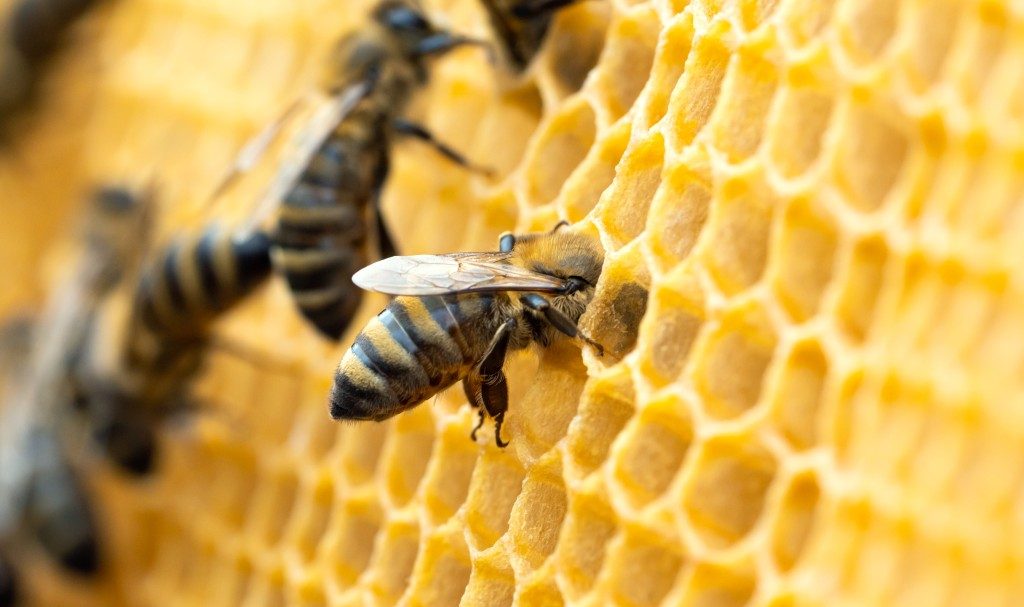
AsianScientist (Aug. 13, 2026) – We tend to think of royalty as something you are born into: a queen is a queen by blood. Among honeybees, though, the story is a little different. A queen and an ordinary worker begin life as almost identical eggs; what separates them is not birth, but how they are raised.
For a long time, scientists believed this came down to a single ingredient: royal jelly, the protein-rich secretion that nurse bees feed to a chosen larva. Feed a larva enough of it, and a queen emerges. In fact, the idea that the right food alone makes a queen has been the textbook explanation for generations. But a new study in Nature, from researchers at the Institute of Apicultural Research at the Chinese Academy of Agricultural Sciences and their international collaborators, suggests diet is only part of the recipe. There is a third, often overlooked ingredient: the wax cell a queen grows up in.
Honeybee workers build their comb from wax, in neat hexagonal cells. But queens are reared in something quite different — a large, peanut-shaped cell that hangs downwards, and that workers build only when the colony needs a new ruler. Using thermal imaging, behavioural tracking and chemical analysis, the researchers found that these royal cells are not simply roomier shelters. They are made from a distinct kind of wax: softer and less dense than ordinary comb, better at holding on to heat and moisture, and carrying its own chemical signature.
But does the nursery itself really matter? To find out, the team raised developing queens in cells made either from queen wax or ordinary worker wax, feeding them the very same royal diet. The difference was striking. Larvae raised in worker wax were more likely to die, and those that survived grew into smaller queens. The wax, it seems, does as much work as the food.
The study also revealed who is behind all this. The researchers identified a previously unrecognised group of young workers as “queen cell builders” that seem specially equipped for the task. These builders run warmer than their sisters and shift their own physiology while tending future queens. Rather than reusing old comb, they actively gather and rework the wax destined for royal cells. In one neat test, the team laced ordinary honeycomb with traces of graphite, and later spotted the darkened wax turning up in queen cells, a sign the builders were selectively repurposing material for royal use. The extra warmth pays off, too: queens mature in about 16 days, against roughly 21 for a worker.
There is, as Boris Baer, an entomologist at the University of California, Riverside, whose lab contributed to the work, put it, “an entire machinery behind this process” — far more sophisticated than anyone had assumed.
Interestingly, the same pattern turned up in both Asian and European honeybees, hinting that this is a deeply rooted strategy. And it points to something broader: that development is shaped not by genes and food alone, but by the environments, and the societies, that build them.
—
Source: Institute of Apicultural Research ; Image: Magnific/aleksrybalko
The study can be found at: Queen cell architecture shapes honey bee queen development
Disclaimer: This article does not necessarily reflect the views of AsianScientist or its staff.
Kavitha Kannan is a biologist and science writer. She holds a PhD in animal behaviour and neuroscience from the University of Konstanz, Germany.
EDITOR’S PICK
| # | Наименование новости | Тональность | Информативность | Дата публикации |
|---|---|---|---|---|
| 1 | Benefits in Flexibility: Responses to Changing Social and Environmental Conditions in Bumble Bees | 0 | 6.96 | 04-08-2026 |
| 2 | Bees Have a Hidden Nutritional Superpower, Oxford Study Reveals | 0 | 18.4 | 20-07-2026 |
| 3 | New Research Questions a Textbook Theory of How Insect Societies Evolve | 0 | 19.34 | 09-08-2026 |
| 4 | Se derrumba una creencia científica de décadas: por error descubren que la jalea real no es la clave para crear abejas reinas | 0 | 7 | 15-07-2026 |
| 5 | Bumblebees Make ‘Yum’ And ‘Eww’ Faces, Study Finds | 0 | 14.75 | 07-08-2026 |
| 6 | Food supplements could help bees cope with climate crisis, research suggests | 2 | 6 | 15-07-2026 |
| 7 | Why Are Wasps Disappearing This Summer? | 0 | 19.84 | 08-08-2026 |
| 8 | Coffee’s Most Destructive Pest Is Accidentally Helping the Ants That Hunt It | 0 | 18.71 | 03-08-2026 |
| 9 | Scientists Are Turning Empty Roadsides Into Butterfly Habitats | 0 | 20.83 | 24-07-2026 |
| 10 | ЗНАКОМСТВО С 6-М ОТДЕЛОМ⚡️ Всем привет! На связи шестой отдел, ... | 0 | 5.75 | 22-08-2026 |