Просмотр новости
Найдите то, что Вас интересует
 Спутники
 РН
РН SpaceX
 Роскосмос
 NASA
NASA
СпутникиРНSpaceXРоскосмосNASAJust weeks after a severe heatwave that broke all-time May records, Europe is experiencing another major heatwave that is breaking June and annual records. This is particularly remarkable given that June is not historically the hottest month in Western Europe. Across France, Germany, Italy, Spain, and southern England, temperatures are reaching 5–12°C above seasonal averages, … Continue reading "Fossil fuel emissions have rapidly worsened European heatwaves in just a few decades"
Just weeks after a severe heatwave that broke all-time May records, Europe is experiencing another major heatwave that is breaking June and annual records. This is particularly remarkable given that June is not historically the hottest month in Western Europe. Across France, Germany, Italy, Spain, and southern England, temperatures are reaching 5–12°C above seasonal averages, driven by a persistent high-pressure system. This pattern has transported hot air from North Africa into the region while also bringing clear skies and strong sunshine, which have further intensified the heat.
Heatwaves pose a serious threat to human health and have profound impacts on ecosystems. During the summer of 2022, more than 60,000 people across Europe died as a result of extreme heat. Even in the following summer, which was significantly cooler, over 47,000 heat-related deaths were recorded (Gallo et al., 2024). Last year, the first heatwave in Europe, also hitting at the end of June, cost an estimated 2,300 people their lives in only 12 European cities (Grantham Institute, 2025).
In addition to the direct impact on mortality, extreme heat affects ecosystems, infrastructure services and daily life. The high temperatures are pushing cooling demand to its highest level in at least 45 years while significantly increasing wildfire risk, particularly in Spain and France (Straits Times, 2026). France has been among the hardest-hit countries, already reporting at least 40 fatalities, widespread school closures, cancelled outdoor events, and major rail disruptions as extreme heat leads to thermal expansion of tracks and disruption to overhead power lines (Guardian, 2026). Dry conditions are intensifying, with soil moisture approaching record seasonal lows and emergency medical calls rising by 20% (Joubioux, 2026; Peseckyte, 2026a; Reuters, 2026; Straits Times, 2026). In the UK, East Surrey Hospital declared a critical incident due to surging demand, restricting services to life-threatening emergencies only (Peseckyte, 2026b). Italy has experienced heat-related deaths, increased emergency-room admissions, and power outages linked to soaring air-conditioning use, while healthcare and transport systems in Belgium and the Netherlands have faced growing strain and service disruptions. In Belgium, wildlife rescue centres have also reported a sharp rise in heat-stressed animals, particularly young birds (Reuters, 2026). Meanwhile, Spain is confronting heightened drought and water-stress conditions as reservoir levels come under increasing pressure. The heatwave is also placing stress on European energy systems, with concerns over reduced output from French nuclear power plants cooled by the Rhône and Garonne rivers. As France forms a key part of the continent’s electricity network, generation restrictions could tighten regional power supplies and contribute to higher electricity prices and worsen Europe’s growing summer energy poverty (Straits Times, 2026; European Commission, n.d.).
Researchers from Sweden, Denmark, the United States, the Netherlands, Ireland and the United Kingdom collaborated to assess to what extent human-induced climate change altered the likelihood and intensity of the extreme heat in Western Europe. The analysis focuses on the 3 hottest days and nights over the most affected area (red outline, Figure 1), and additional analysis of the 19 capitals of the affected countries.
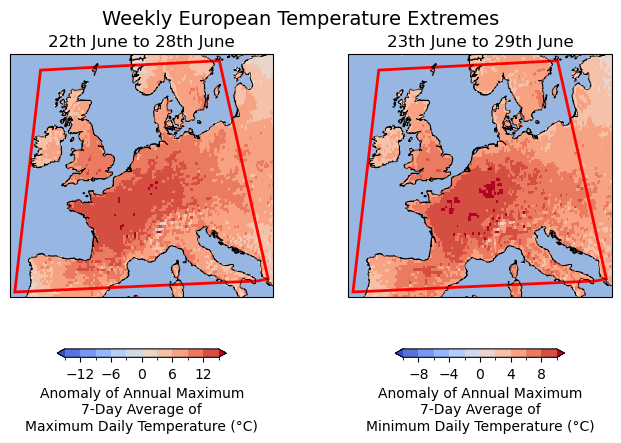
Figure 1: The anomaly in the 7-day average for peak minimum and maximum daily temperature relative to a 1991-2020 June climatology.
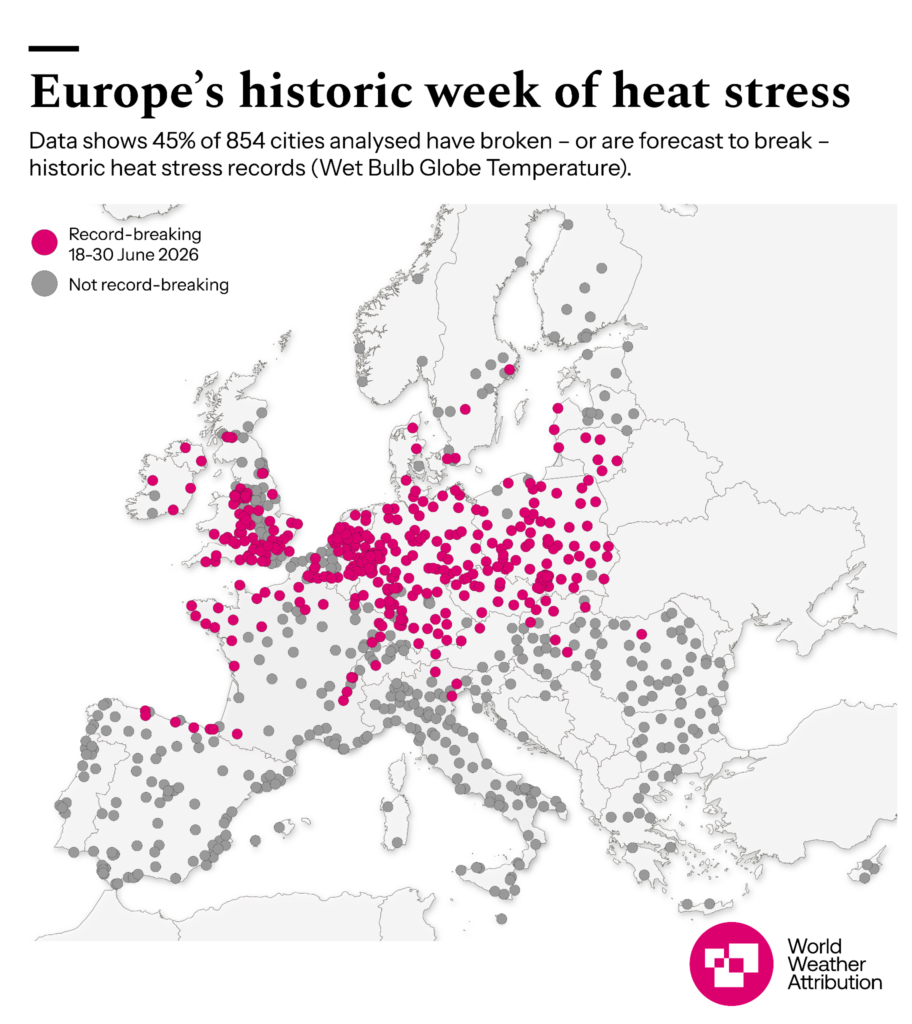
Figure 2: the cities (EU + Switzerland + UK + Norway urban regions with a population of over 50,000) where WBGT records were broken (or forecast to be broken) during this heatwave. A record was broken in approximately 45% of urban regions.
Main Findings*Wet Bulb Globe Temperature (WBGT)
To measure the combined effect of environmental factors on human heat stress, Wet Bulb Globe Temperature (WBGT) is used as a composite index, combining humidity, radiant heat (such as direct sunlight), and air movement, all of which affect the body’s ability to regulate its internal temperature through sweating and heat exchange. By capturing these interacting variables, WBGT provides a more physiologically relevant assessment of thermal strain, particularly during outdoor physical activity. Consequently, it is widely applied in fields such as sports science and occupational health (Grundstein et al., 2023).
In this study we approximate WBGT using temperature and humidity (per Zhang et al., 2024) – which means results apply best to a sheltered and shaded area, without the heating effect of direct sunlight or the cooling effect of wind.
| # | Наименование новости | Тональность | Информативность | Дата публикации |
|---|---|---|---|---|
| 1 | Heatwave across western Europe – in pictures | 0 | 7 | 10-07-2026 |
| 2 | Western Europe records its hottest June as heat waves surge: EU monitor | 0 | 7 | 09-07-2026 |
| 3 | Increasingly hot Europe faces more severe droughts and growing challenges for water and land management | 0 | 10.6 | 22-07-2026 |
| 4 | Europe swelters through record heat as drought and wildfires intensify | 0 | 7.92 | 12-08-2026 |
| 5 | Climate change is driving unprecedented European ocean temperatures, with severe impacts for marine life | 0 | 8.91 | 18-08-2026 |
| 6 | Hitze und Trockenheit: Juni und Juli waren in Westeuropa so warm wie noch nie | 0 | 9.84 | 10-08-2026 |
| 7 | Peak heat in Europe just broke historic 1970s records | 0 | 8.44 | 09-07-2026 |
| 8 | Western Europe records its hottest June as heatwaves surge | 0 | 7 | 09-07-2026 |
| 9 | Europe Is the Fastest-warming Continent and This Brutal Heatwave Shows What That Means | 0 | 23.14 | 25-06-2026 |
| 10 | Climate change exposes hundreds of millions to longer and deadlier pre-monsoon heat in South Asia | 0 | 10.39 | 14-05-2026 |