Просмотр новости
Найдите то, что Вас интересует
 Спутники
 РН
РН SpaceX
 Роскосмос
 NASA
NASA
СпутникиРНSpaceXРоскосмосNASAEngineers are borrowing this insect’s trick, an "invisibility cloak" of anti-reflective spheres. It could lead to new clean energy tech or military gear.
From Harry Potter to The Lord of The Rings, tall tales regale us with the potential benefits of invisibility. Many researchers would like to bring such benefits to the real world. One new tech might allow some things to practically hide in plain sight. Its inspiration: the common backyard leafhopper.
A camouflage artist, this insect is an expert nanoengineer.
An adult leafhopper coats its body with a liquid. That goo is filled with tiny, complex nanospheres. These anti-reflective, soccer-ball-shaped objects are called brochosomes (BROK-ih-zoams). As light hits them, they change its behavior, explains Roman Rakitov. He works at the Russian Academy of Sciences in Moscow. An insect biologist, he did not work on the new study.
Those brochosomes cut the reflection of both visible and ultraviolet (UV) light. Instead of being shiny and eye-catching, the leafhopper becomes rather dull — like its surroundings. Something that reflects little to no light can become nearly invisible. So those nanostructures in the leafhopper’s coat make it “less visible to some predators,” explains Rakitov. That’s especially true for predators that see only in UV, such as some birds and insects.
Researchers at Penn State University in State College have now developed a technique to mass-produce synthetic brochosomes. They say these structures might one day pave the way to next-gen camouflage and anti-reflective coatings.
Submit your question here, and we might answer it an upcoming issue of Science News Explores
Engineers often draw inspiration from nature for cloaking and other camouflage techniques. Some fish, for instance, reflect polarized light to hide in the open ocean. Glasswing butterflies use waxy bumps on their wings to reflect less light. Tak-Sing Wong wondered if he could cloak things by coating them with brochosomes.
A mechanical engineer, Wong works at Penn State. He saw potential in brochosomes for making anti-reflective paints and other coatings.
Through a microscope, brochosomes resemble tiny balls with hollow centers. A honeycomb grid of holes covers their surface. When Wong first saw a picture of them, he thought they must be human-made. “How on Earth can a simple insect make such a complex structure?” he recalls wondering.
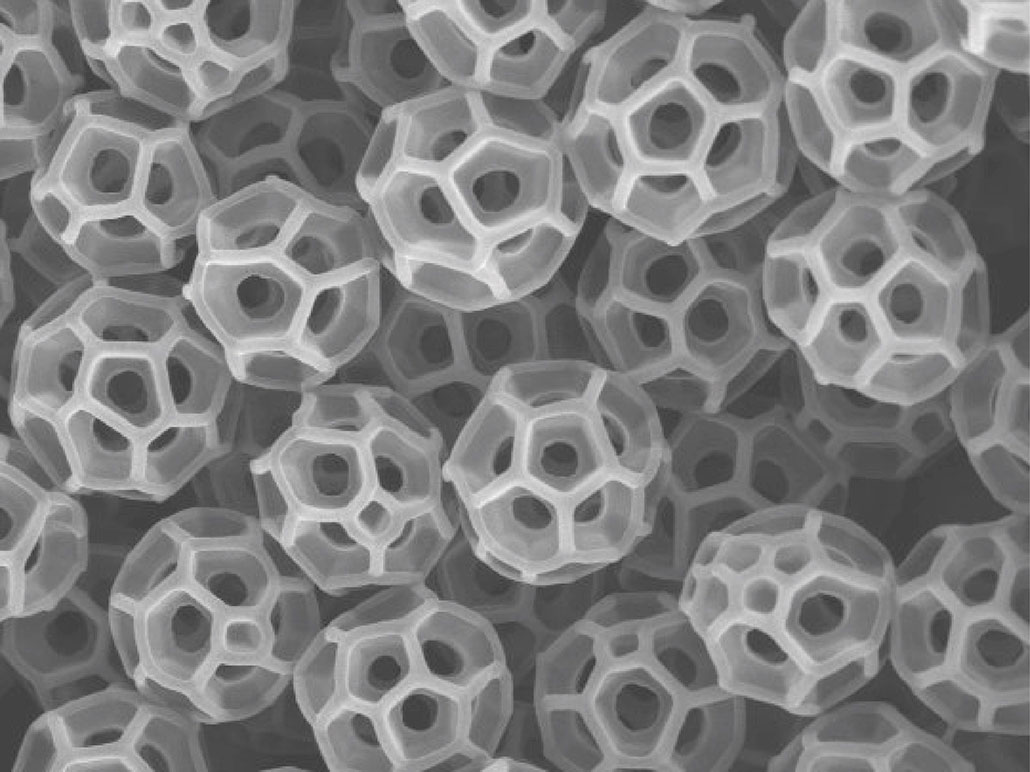 This electron microscope image of brochosomes on a leafhopper’s wing reveals their soccer-ball-like geometry. The structures absorb and scatter light, which can turn the insects nearly invisible to many predators. How well they do this depends on the size and pattern of the brochosomes’ holes.Jinsol Choi and T-S. Wong/Penn State
He suspected that 3-D structure was key to a brochosome’s ability to fight glare. But copying its structure proved tricky. Each sphere is less than one-millionth of a meter across. (It would take 70 of these balls lined up to match the width of a single human hair.)
In 2024, Wong’s team used a 3-D printing method to re-create the shape of these complex balls. They designed ones with holes of different shapes and sizes. Then they tested which of them reflected the least light.
Alas, their 3-D printing method wouldn’t easily make large amounts of these balls. And without that, the tech would not be practical for real-world use.
Once again, Wong’s team turned to the leafhoppers for inspiration.
How to make molecules assembleLeafhoppers make their brochosomes in specialized organs. Called Malpighian (Mal-PIG-ee-un) tubules, they’re part of the insect’s waste-removal system. One part of this organ secretes proteins and fatty molecules called lipids.
Those molecules later come together on their own, says Elizabeth Bello. The proteins and lipids first join to make a round blob. Holes and pits then develop on its surface. Scientists don’t yet know the exact chemistry that drives this shaping, Bello adds.
The biologist did not take part in this new study. But she does appreciate it. Her lab studies brochosomes at the University of Illinois Urbana-Champaign.
To mimic the ball-making process in leafhoppers, Wong’s team turned to microfluidics. This field of research involves the precise control of very small amounts of fluid.
Learn more about a leafhopper’s protective cloak of brochosomes. The light-gobbling ability of synthetic brochosomes might one day help them find a range of important uses.Their fluid contained a mix of what are called amphiphilic (Am-fih-FIH-lik) molecules. They contain some parts that are attracted to water; other parts are drawn to oil. These molecules mimic the proteins and lipids that make natural brochosomes. And under the right conditions, they similarly self-assemble into 3-D structures.
Wong’s group created special oil droplets. Each droplet had a bit of water trapped inside. This encourages the amphiphilic molecules to organize themselves within the droplets. The oil-loving parts tended to stick to the oily side of the droplets. The water-loving parts moved toward the water.
In this way, polymers gathered at the droplet’s edge. They formed a neat layer. Here, they also self-assembled into honeycomb shapes that mimic brochosomes. Once they hardened, they even exhibited geometry and surface patterns that looked like the leafhoppers’.
To test their particles’ anti-reflective traits, Wong’s group coated different surfaces with these lab-made brochosomes. And this coating effectively reduced glare and reflection, they now report. The team shared details of it last December in ACS Nano.
The particles cut glare from any viewing angle. That’s an advance over current anti-reflective coatings. Most others work best only when viewed from a certain angle. Many smartphone screens, for instance, have a privacy feature. It makes the screen appear blank when you glance at it from the side. But from the front, the screen is visible.
One major advance, Wong says, was his team’s ability to tightly control how their particles formed. They could adjust the mix of molecules and how big the droplets were. Such tweaks would coax the structures to take on slightly different shapes. Some might get thicker walls. Others got larger holes. Importantly, their microfluidic system could pump out droplets extremely fast — 100,000 or more each second!
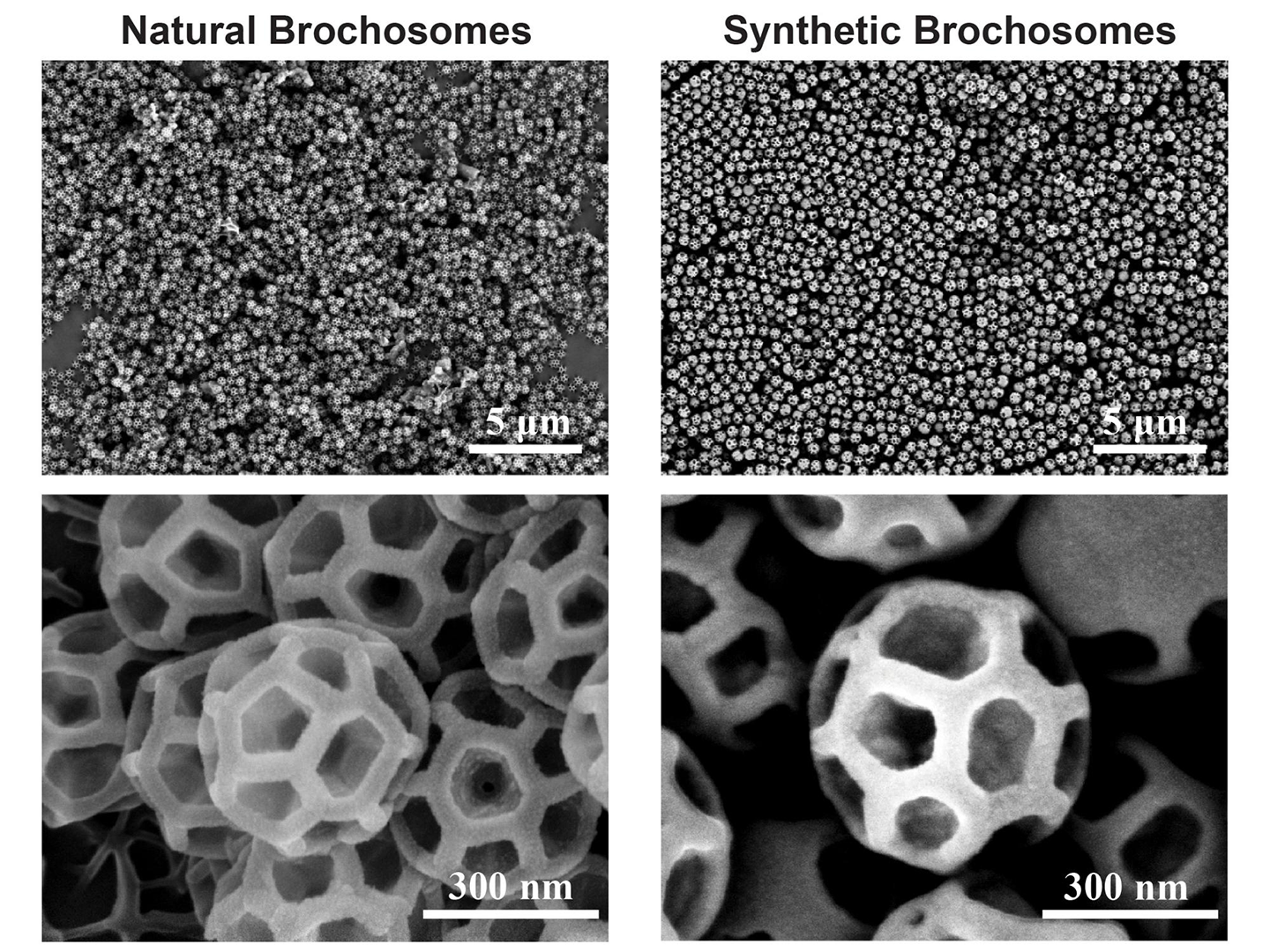 This electron microscope image shows synthetic brochosomes created by the Penn State team (right). They look remarkably like the real thing (left). They’re even the same size (nm scale indicates they are about 300 nanometers across).Jinsol Choi and T-S. Wong/Penn State
“I was really excited to read [this study],” says Bello. A small handful of research groups have recently made brochosome-like materials, she notes. “But they could only be produced in limited quantities,” she says. “Having a method to mass-produce brochosome-like particles is a significant breakthrough.”
Wong says his team’s work has many potential applications. Eyeglass lenses, solar panels and other optical surfaces are often coated to reduce glare or reflection. The faux brochosomes might work even better than those. Anti-glare tech has also found use in military gear and self-cleaning surfaces.
3-D: Short for three-dimensional. This term is an adjective for something that has features that can be described in three dimensions — height, width and length.
3-D printing: The creation of a three-dimensional object with a machine that follows instructions from a computer program. The computer tells the printer where to lay down successive layers of some raw material, which can be plastic, metals, food or even living cells. 3-D printing is also called additive manufacturing.
angle: The space (usually measured in degrees) between two intersecting lines or surfaces at or close to the point where they meet.
application: A particular use or function of something.
biologist: A scientist involved in the study of living things.
camouflage: Hiding people or objects from an enemy by making them appear to be part of the natural surroundings. Animals can also use camouflage patterns on their skin, hide or fur to hide from predators.
chemistry: The field of science that deals with the composition, structure and properties of substances and how they interact. Scientists use this knowledge to study unfamiliar substances, to reproduce large quantities of useful substances or to design and create new and useful substances. (about compounds) Chemistry also is used as a term to refer to the recipe of a compound, the way it’s produced or some of its properties. People who work in this field are known as chemists. (in social science) A term for the ability of people to cooperate, get along and enjoy each other’s company.
develop: To emerge or to make come into being, either naturally or through human intervention, such as by manufacturing.
engineer: A person who uses science and math to solve problems. As a verb, to engineer means to design a device, material or process that will solve some problem or unmet need.
entomologist: A biologist who specializes in the study of insects. A paleoentomologist studies ancient insects, mainly through their fossils.
generation: A group of individuals (in any species) born at about the same time or that are regarded as a single group. Your parents belong to one generation of your family, for example, and your grandparents to another. Similarly, you and everyone within a few years of your age across the planet are referred to as belonging to a particular generation of humans. The term also is sometimes extended to year classes of other animals or to types of inanimate objects (such as electronics or automobiles).
geometry: The mathematical study of shapes, especially points, lines, planes, curves and surfaces. Geometry can also refer to the defined shape of something (such as it had a very spherical geometry).
glare: Bright light reflected off of a surface, such as water or pavement. (also direct glare) The light that travels directly from a light source and into someone’s eyes, making it difficult to discern details.
insect: A type of arthropod that as an adult will have six segmented legs and three body parts: a head, thorax and abdomen. There are hundreds of thousands of insects, which include bees, beetles, flies and moths.
lens: (in optics) A curved piece of transparent material (such as glass) that bends incoming light in such a way as to focus it at a particular point in space. Or something, such as gravity, that can mimic some of the light bending attributes of a physical lens.
lipid: The term for a family of fatty compounds, from cholesterol and wax to triglycerides. The four big categories include triglycerides, waxes, steroids and phospholipids.
Malpighian tubules: Thin, hairlike organs in some arthropods, including insects. They collect liquid wastes from fluids in the body and them send them to the hind gut, from which they’ll be excreted as urine. These tubules are named for Marcello Malpighi, a 17th century Italian anatomist. He described them for the first time in a 1669 report on silkworms.
mechanical engineer: Someone trained in a research field that uses physics to study motion and the properties of materials to design, build and/or test devices.
microscope: An instrument used to view objects — such as bacteria or the single cells of plants or animals — that are too small to be visible to the unaided eye.
microscopic: An adjective for things too small to be seen by the unaided eye. It takes a microscope to view objects this small, such as bacteria or other one-celled organisms.
molecule: A group of atoms that represents the smallest possible amount of a chemical compound. Molecules can be made of single types of atoms or of different types. For example, the oxygen in air is made of two bound oxygen atoms (O2). Water is made of two hydrogen atoms and one oxygen atom (H2O).
nano: A prefix indicating a billionth. In the metric system of measurements, it’s often used as an abbreviation to refer to objects that are a billionth of a meter long or in diameter.
optical: An adjective that refers to light or vision.
organ: (in biology) Various parts of an organism that perform one or more particular functions. For instance, an ovary is an organ that makes eggs, the brain is an organ that makes sense of nerve signals and a plant’s roots are organs that take in nutrients and moisture.
particle: A minute amount of something.
polymer: A substance made from long chains of repeating groups of atoms. Manufactured polymers include nylon, polyvinyl chloride (better known as PVC) and many types of plastics. Natural polymers include rubber, silk and cellulose (found in plants and used to make paper, for example).
predator: (adjective: predatory) A creature that preys on other animals for most or all of its food.
protein: A compound made from one or more long chains of amino acids. Proteins are an essential part of all living organisms. They form the basis of living cells, muscle and tissues; they also do the work inside of cells. Antibodies, hemoglobin and enzymes are all examples of proteins. Medicines frequently work by latching onto proteins.
recall: To remember.
secrete: (noun: secretion) The natural release of some liquid substance — such as hormones, an oil or saliva — often by an organ of the body.
smartphone: A cell (or mobile) phone that can perform a host of functions, including search for information on the internet.
solar: Having to do with the sun or the radiation it emits. It comes from sol, Latin for sun.
synthetic: An adjective that describes something that did not arise naturally, but was instead created by people. Many synthetic materials have been developed to stand in for natural materials, such as synthetic rubber, synthetic diamond or a synthetic hormone. Some may even have a chemical makeup and structure identical to the original.
system: A network of parts that together work to achieve some function. For instance, the blood, vessels and heart are primary components of the human body's circulatory system. Similarly, trains, platforms, tracks, roadway signals and overpasses are among the potential components of a nation's railway system. System can even be applied to the processes or ideas that are part of some method or ordered set of procedures for getting a task done.
technology: The application of scientific knowledge for practical purposes, or the devices, processes and systems that result from those efforts.
tubule: A tube-like structure that is extremely tiny.
ultraviolet: A portion of the light spectrum that is close to violet but invisible to the human eye.
wavelength: The distance between one peak and the next in a series of waves, or the distance between one trough and the next. It’s also one of the “yardsticks” used to measure radiation. Visible light — which, like all electromagnetic radiation, travels in waves — includes wavelengths between about 380 nanometers (violet) and about 740 nanometers (red). Radiation with wavelengths shorter than visible light includes gamma rays, X-rays and ultraviolet light. Longer-wavelength radiation includes infrared light, microwaves and radio waves.
| # | Наименование новости | Тональность | Информативность | Дата публикации |
|---|---|---|---|---|
| 1 | New 3D thermal cloak hides objects from heat in any direction | 7 | 8 | 13-07-2026 |
| 2 | В США захотели имитировать китайские истребители-невидимки | 0 | 26.67 | 18-08-2026 |
| 3 | New 3D thermal cloak hides heat from infrared cameras | 0 | 7.82 | 29-07-2026 |
| 4 | Инженеры из США создали технологию «лживое зеркало» | 0 | 7.93 | 13-08-2026 |
| 5 | Scientists develop diving suits for cyborg cockroach swarms - and it could enable them to explore Mars | 5 | 7 | 05-07-2026 |
| 6 | Камуфляж нового уровня. В США создали технологию «лживое зеркало» | 0 | 10 | 16-08-2026 |
| 7 | Инженеры из США создали делающий объекты невидимыми для тепловизоров 3D-плащ | 0 | 8.26 | 24-07-2026 |
| 8 | Scientists turn tiny “defects” into a 5.5x heat transfer boost | 0 | 9.68 | 23-08-2026 |
| 9 | This Band Aid-like device could let you ‘feel’ the virtual world | 0 | 14.31 | 08-04-2026 |
| 10 | Russia develops latest Fantom camouflage cape, concealing soldier’s silhouette | 0 | 12.74 | 10-08-2026 |