Просмотр новости
Найдите то, что Вас интересует
 Спутники
 РН
РН SpaceX
 Роскосмос
 NASA
NASA
СпутникиРНSpaceXРоскосмосNASAUsing a grid of tiny, fast-moving dots, this device realistically renders virtual textures by mimicking the feel of real-world objects.
Phones, tablets and other electronic gadgets display lifelike images and play realistic sounds. What’s next? Maybe, making virtual objects feel real.
A new device that’s worn on your fingertip — like a Band-Aid — is a step in that direction. It’s designed to replicate the sensation of touch.
In early tests, volunteers wearing this device could identify patterns of virtual indentations on smooth test surfaces. They also could tell the difference between rough and smooth virtual fabrics.
This is the first tech that allows fingertips to feel virtual textures with the same speed and detail as when they’re touching real-world objects, its designers say. They described this device — named VoxeLite — in Science Advances late last year.
VoxeLite is an example of haptic, meaning touch-related, technology. Today, haptic feedback on personal devices is mostly limited to simple vibrations. But future haptic tech could add realistic touch features, says Thanh Nho Do. This materials scientist works at the University of New South Wales in Sydney, Australia. He did not take part in building VoxeLite, but he does develop haptic devices in his own lab.
In future versions, “users could explore the material properties of clothing” when shopping online, Do suggests. Before purchasing a new hoodie, for instance, someone could feel how soft it is.
This type of tech might also, one day, help blind people read messages or maps on a phone, says Sylvia Tan. A materials scientist and graduate student at Northwestern University in Evanston, Ill., she led the design of VoxeLite.
The device isn’t ready for widespread use, Tan says. “There is still a lot of work to be done.” But she thinks that work is worth doing. “Touch plays a fundamental role in how we interact with the world,” Tan says. “Yet it remains one of the least digitized senses.”
Tiny pixels of touchEngineers and materials scientists have built many types of haptic devices. Some, like Do, have created gloves with tiny vibrating pieces. Others have used little motors that buzz against the fingertips. Still others have designed a soft skin-like covering that morphs into shapes against a user’s skin to match the surfaces of textures.
Many of those earlier devices worked too slowly to feel realistic, says Tan. Others couldn’t achieve the detail of many textures. The new device, she says, achieves both.
VoxeLite is a paper-thin piece of stretchy latex. It wraps around the user’s finger like a bandage. Embedded within it is a square grid of tiny half-spheres, called nodes. They’re linked by wires. Each node can be independently controlled. The flat side of each one sits against the pad of the wearer’s fingertip.
Tan and her team created devices with those nodes in 4×4 grids, 6×6 grids and 8×8 grids. The challenge, she says, was to put nodes close enough together that they could mimic fine details of textures, yet far enough apart that your brain would recognize them as different nodes.
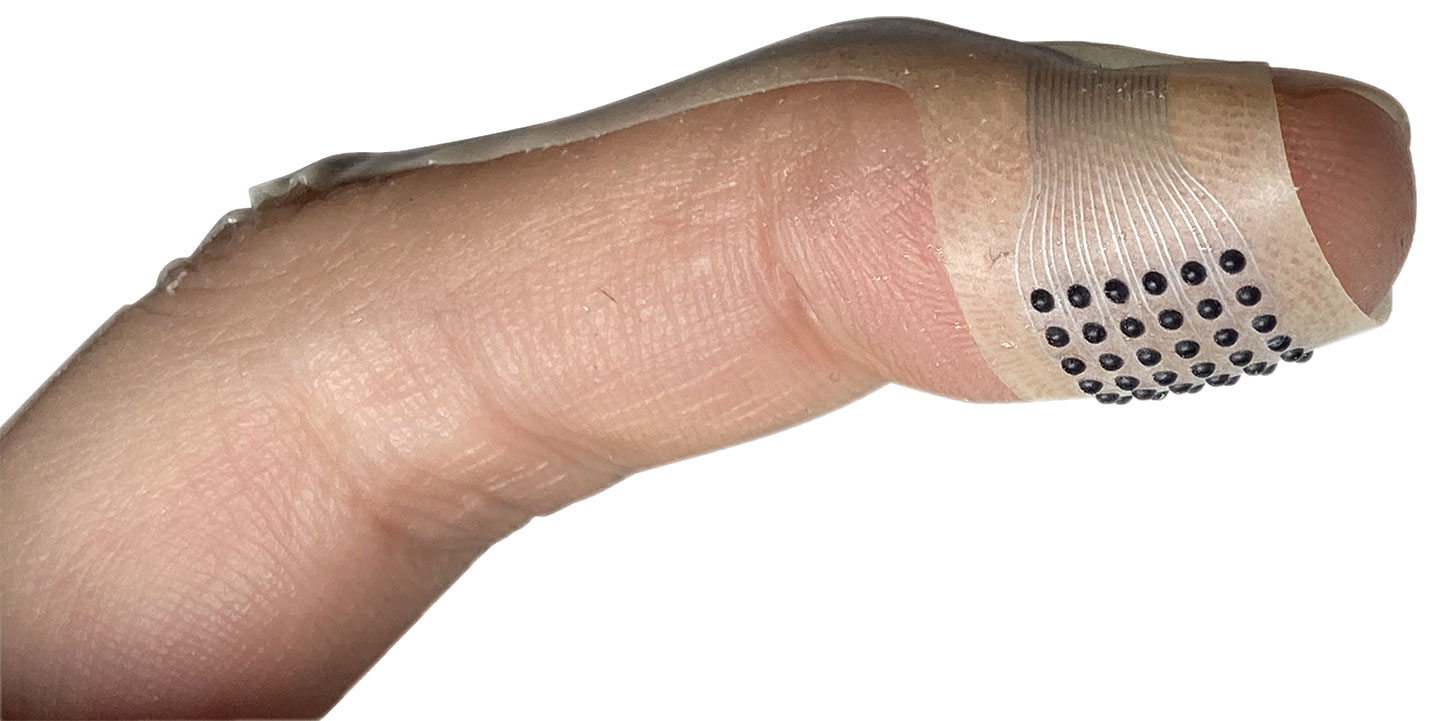 The black dots on the tape are nodes. When someone touches an electrically conductive surface, those nodes turn and vibrate in ways that feel like textures touching your skin. Northwestern University
In the version of the device tested by volunteers, the nodes were spaced with their centers 1.6 millimeters (0.06 inch) apart. That grid density, Tan says, let the device convincingly mimic how materials feel to the skin.
The current prototype starts working when someone slides their finger along a smooth surface that can conduct electricity. As the finger moves, the nodes pick up electrical signals in the form of voltage. That voltage leads to a difference in electric charge between each node and the surface. And that difference in charge leads to friction.
Friction causes a node to tilt in a particular way, pushing the flat part of the dome into the person’s skin. Higher voltage leads to more friction, which mimics a rough surface. Less voltage creates less friction and feels smoother.
The nodes can change quickly — up to 800 times per second — as someone moves their finger. That’s because where many past devices used tiny motors, VoxeLite instead relies on quick-changing charges. Those changes create vibrations against the skin. All the nodes, vibrating and tilting in specific ways, add up to sensations.
Submit your question here, and we might answer it an upcoming issue of Science News Explores
In tests, people wearing VoxeLite were first asked to identify which directions were represented by patterns on the nodes. Those directions were right, left, forward, back or going in a loop. Nodes nearest the tip of the finger might tilt the most, guiding the person in that direction. Or nodes on the left might indent into the skin, signaling left.
Next, users were asked to match the sensations they felt to the textures of real materials, such as leather and corduroy.
The volunteers correctly identified directions 87 percent of the time. They correctly matched virtual textures to real-world materials 81 percent of the time.
The new device can mimic finer textures than other haptic devices, Do says. But to work, he notes, the finger-worn device needs to move against a conductive (and electrically grounded) surface. Most objects don’t conduct electricity. “As a result, the device cannot function on most everyday objects,” he says. Those include the touchscreens on today’s smartphones and computers. They do conduct electricity. Their protective layers of glass or plastic, however, keep the new device from working on them, Tan notes.
This latest version of VoxeLite took about two years of work, and its developers are still refining it. Tan hopes it will allow her to better understand how people perceive touch. She also wants to bring down its size. Even though the device itself fits on a fingertip, it’s connected by wires to a much larger circuit on her desk.
Eventually, she hopes others will improve on her work to develop better haptic tools. She says she’s “excited to see where others might find this new type of tactile information most useful.”
circuit: A network that transmits electrical signals. In the body, nerve cells create circuits that relay electrical signals to the brain. In electronics, wires typically route those signals to activate some mechanical, computational or other function.
conductive: Able to carry an electric current.
current: (in electricity) The flow of electricity or the amount of charge moving through some material over a particular period of time.
density: The measure of how condensed some object is, found by dividing its mass by its volume.
develop: To emerge or to make come into being, either naturally or through human intervention, such as by manufacturing.
electricity: A flow of charge, usually from the movement of negatively charged particles, called electrons.
engineer: A person who uses science and math to solve problems. As a verb, to engineer means to design a device, material or process that will solve some problem or unmet need.
fabric: Any flexible material that is woven, knitted or can be fused into a sheet by heat or compression and drying.
friction: The resistance that one surface or object encounters when moving over or through another material (such as a fluid or a gas). Friction generally causes a heating, which can damage a surface of some material as it rubs against another.
function: The specific role some structure or device plays.
fundamental: Something that is basic or serves as the foundation for another thing or idea.
glass: A hard, brittle substance made from silica, a mineral found in sand. Glass usually is transparent and fairly inert (chemically nonreactive). Aquatic organisms called diatoms build their shells of it.
graduate student: Someone working toward an advanced degree by taking classes and performing research. This work is done after the student has already graduated from college (usually with a four-year degree).
haptics: A field of research that involves the sense of touch. The term also can refer to building in the ability to convey or receive touch sensations through machines or other devices. Adding a tactile component to virtual reality, for instance, could make the environments they simulate seem more natural or realistic.
materials scientist: A researcher who studies how the atomic and molecular structure of a material is related to its overall properties. Materials scientists can design new materials or analyze existing ones. Their analyses of a material’s overall properties (such as density, strength and melting point) can help engineers and other researchers select materials that are best suited to a new application.
morph: (in non-living systems) It refers to a thing, policy or activity that has undergone change, becoming something that looks or seems new and different.
motor: A device that converts electricity into mechanical motion. (in biology) A term referring to movement.
New South Wales: One of the Eastern states that make up Australia. Home to some 8 million people, it’s the oldest, largest and most urban of those states. Located in the east-central and southeastern part of the nation, most of its residents live in or near the state capital of Sydney.
node: A person or thing in a network.
pixel: Short for picture element. A tiny area of illumination on a computer screen, or a dot on a printed page, usually placed in an array to form a digital image. Photographs are made of thousands of pixels, each of different brightness and color, and each too small to be seen unless the image is magnified.
prototype: A first or early model of some device, system or product that still needs to be perfected.
tablets: (in computing) A type of small, hand-held computer that can connect to the internet and that users can control using a touch screen.
tactile: An adjective that describes something that is or can be sensed by touching.
technology: The application of scientific knowledge for practical purposes, or the devices, processes and systems that result from those efforts.
virtual: Being almost like something. An object or concept that is virtually real would be almost true or real — but not quite. The term often is used to refer to something that has been modeled by (or accomplished by) a computer using numbers, not by using real-world parts. So a virtual motor would be one that could be seen on a computer screen and tested by computer programming (but it wouldn’t be a three-dimensional device made from metal). (in computing) Things that are performed in or through digital processing and/or the internet. For instance, a virtual conference may be where people attended by watching it over the internet.
voltage: A force associated with an electric current that is measured in units known as volts. Power companies use high-voltage to move electric power over long distances.
Stephen Ornes lives in Nashville, Tenn., and his family has two rabbits, six chickens and a cat. He has written for Science News Explores since 2008 on topics including lightning, feral pigs, big bubbles and space junk.
| # | Наименование новости | Тональность | Информативность | Дата публикации |
|---|---|---|---|---|
| 1 | New 3D thermal cloak hides objects from heat in any direction | 7 | 8 | 13-07-2026 |
| 2 | Shape-shifting surface morphs in real time for next-generation human-machine interaction | 5 | 7 | 29-06-2026 |
| 3 | Cornell engineers use tiny vibrating beams to rethink AI hardware | 0 | 8.98 | 01-06-2026 |
| 4 | VR can train the human brain to treat wings like real limbs | 0 | 7.35 | 06-07-2026 |
| 5 | Backyard leafhoppers inspire next-generation cloaking tech | 0 | 15.98 | 13-04-2026 |
| 6 | Wearable glove turns data into heat and touch for more personal insights | 0 | 5 | 18-06-2026 |
| 7 | New AR display tech boosts real‑world visibility while keeping virtual objects lifelike | 0 | 7 | 19-07-2026 |
| 8 | Retina e-paper promises screens 'visually indistinguishable from reality' | 0 | 9.78 | 23-10-2025 |
| 9 | Listen: How brain-machine interfaces could help paralyzed patients | 0 | 11.82 | 18-09-2026 |
| 10 | Stanford scientists create shape-shifting material that changes color and texture like an octopus | 0 | 7.66 | 31-03-2026 |