Просмотр новости
Найдите то, что Вас интересует
 Спутники
 РН
РН SpaceX
 Роскосмос
 NASA
NASA
СпутникиРНSpaceXРоскосмосNASAE. Michael Jones is a prolific writer and the author of books such as Libido Dominandi: Sexual Liberation and Political Control, Barren Metal: A History of Capitalism as the Conflict between Labor and Usury, The Dangers of Beauty, etc. He has been described as "a one-legged man in an ass-kicking contest," a colorful expression used...
List of Bookmarks
E. Michael Jones is a prolific writer and the author of books such as Libido Dominandi: Sexual Liberation and Political Control, Barren Metal: A History of Capitalism as the Conflict between Labor and Usury, The Dangers of Beauty, etc . He has been described as “a one-legged man in an ass-kicking contest,” a colorful expression used to emphasize his willingness to challenge the Powers That Be and prevailing cultural trends despite facing significant opposition.
JEA: I read Libido Dominandi: Sexual Liberation and Political Control back in 2006. I often tell people that if they want to understand how powerful elites have historically used sex to influence and control society, they should get a copy of that book. In it, you discuss at length the ideas behind the French Revolution, Adam Weishaupt’s secret society, and Sigmund Freud’s psychoanalysis. In my opinion, the book is worth every penny. In fact, every book you write is like a college course and is worth every penny. I have never been disappointed because you follow a careful scholarly method. Reading Libido Dominandi gave me a great deal to think about and reconsider. The book has recently been expanded to nearly a thousand pages. Let’s explore some of the themes discussed in the book. You write:
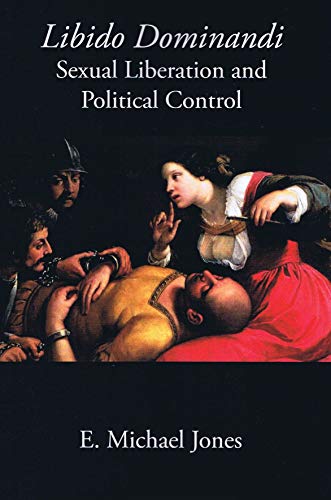
“Psychoanalysis and Illuminism were, in effect the same project—the Illuminist term Seelenanalyse is simply the Germanified term of psychoanalysis or vice versa—with details changed to suit the sensibilities of a later age, an age which believed that ‘science’ and ‘medicine,’ rather than secret societies, would lead to heaven on earth. Both psychoanalysis and Illuminism engaged in what a later critic called ‘Seelenspionage,’ spying on the soul. Both made use of what might be called a Masonic doctrine of two truths as part of their very nature. What the adept knew was not the same as what the controller knew. The patient saw psychoanalysis as a form of liberation; whereas the therapist fostered this illusion as a form of control. Psychoanalysis adopted all of the essential characteristics of Illuminist mind control, but Illuminism can just as easily be seen as an early form of psychoanalysis, a project long cherished by the Enlightenment.â€[1]E. Michael Jones, Libido Dominandi: Sexual Liberation and Political Control (South Bend: St. Augustine’s Press, 2000), 126-127.
()
Some people may find this quite bizarre, but it is not a new idea at all. The late Jewish scholar David Bakan, author of Sigmund Freud and the Jewish Mystical Tradition, said much the same thing.[2]David Bakan, Sigmund Freud and the Jewish Mystical Tradition (New York: Dover Publications, 2004). Richard Noll and other writers, such as Nandor Fodor, have said similar things.[3]Richard Noll, The Jung Cult: Origins of A Charismatic Movement (Princeton: Princeton University Press, 1994); Nandor Fodor, Freud, Jung, and occultism (New York: University Books, 1971).
You discuss Sigmund Freud and Adam Weishaupt at length in the book. In fact, the first chapter begins with Weishaupt and the ideology behind the French Revolution. What are the real connections between these figures and ideas, and do they still have relevance today? Does the modern political and cultural establishment continue to use sex as a form of social or political control, or is this simply a relic of the past?
EMJ: Yes, it’s more relevant now than when I wrote the book almost 20 years ago. The Israelis broadcast pornography over Palestinian TV stations after their invasion of Ramallah. The CIA flooded Portugal with pornography in 1974 and they used it as a weapon when the US invaded Panama in 1989. But there is some indication that the message is getting out. The Polish bishops’ statement denouncing what they call “gender ideology†was based to a large extent on Libido Dominandi, which they got indirectly through Gabriele Kuby’s book.[4]Gabrielle Kuby, The Global Sexual Revolution: Destruction of Freedom in the Name of Freedom (Kettering, OH: Angelico Press, 2012 and 2015), 16-31. I got a letter from a Muslim woman thanking me making the connection between sexual liberation and political control clear to her. This idea clearly has legs now.
JEA: Can you elaborate on the statement that “The CIA flooded Portugal with pornography in 1974 and they used it as a weapon when the US invaded Panama in 1989�
EMJ: By the 1970s, when both Penthouse and Playboy enjoyed their heyday, the CIA began to make use of pornography as one of the weapons on their arsenal of psychological warfare. In 2002 the CIA collaborated with Israel’s Shin Beth in broadcasting pornography over Palestinian TV stations in Ramallah during one Israel’s periodic incursions into Palestinian territory.
During the run-up to the 2003 invasion, the CIA contemplated doing a pornographic featuring a double who looked like Saddam Hussein, as a way of de-legitimizing his government.[5]http://gawker.com/5547523/the-cias-plot-to-make-osa...stars.
In the mid-‘50s the CIA actually produced a pornographic film to bring down President Sukharno of Indonesia.[6]http://williamblum.org/chapters/killing-hope/indonesia. But by the 1970s, it had become clear, if for no other reason than the simple division of labor, that the production of pornography could be out-sourced to people like Robert Guccione (founder and publisher of Penthouse), whose magazines had become more popular with soldiers in Vietnam than Playboy.
By the 1970s, pornography had become one of the psychological weapons of destabilization and control in the CIA’s arsenal of covert warfare. In 1974, the CIA used pornography to derail the communist revolution in Portugal. Someone who was there at the time claimed that after the Thanksgiving weekend revolution of 1974:
“Lisbon area was flooded by some of the most outrageous, blatant, and unbelievably graphic publications I have ever seen. Mrs. Fitzmaurice, our school psychologist, a stringer for Time magazine, published an article entitled ‘Blue Revolution,’ describing the situation. She mentioned that Portugal had surpassed Denmark as the porno center of Europe. That [Ambassador and later CIA director Frank] Carlucci was running Portugal was too obvious to be denied. He apparently had a limitless CIA budget. Former Communists and socialists were now quite wealthy.
ORDER IT NOW
“The planing, organizing, and coordinating of the coup d’etat was carried out at the Elliott Roosevelt Arabian Horse Ranch near Lisbon. (Elliott’s son was in my 11th-grade American History class.) Interestingly, thanks to Salazar, for more than four decades, Portugal had been free of anything sexually graphic, and most things suggestive. All foreign films were censored, with offensive scenes cut. All schoolbooks strongly taught Catholic morality. Beach police enforced a strict bathing suit attire. In less than two years, Lisbon moved from being the most crime-free city of Western Europe to having the highest crime rate, including child rape.â€[7]Personal correspondence.
Frank Carlucci served as Ambassador to Portugal from 1974 to 1977. From 1978 to 1981, Carlucci served as Deputy Director of the CIA under Admiral Stansfield Turner. In December 1974, Time magazine, which established close links with the CIA in 1953 under C. D. Jackson,[8]For a new study on this, see David A. Wemhoff, John Courtney Murray, Time/Life, and the American Proposition: How the CIA’s Doctrinal Warfare Program Changed the Catholic Church (South Bend: Fidelity Press, 2015) who worked simultaneously for both organizations, ran an article on the Marxist revolution in Portugal entitled “Revolutionary Blue.â€[9]“Revolutionary Blue,†Time, 12/23/74, Vol. 104, #26, p. 41. The article, which like all articles at that time was unsigned, did not mention Frank Carlucci, but it did state, in Time’s typically coy fashion:
“There have even been charges that the CIA is sponsoring the new pornography to sap the revolution of its energies. Recently, Premier Vasco Goncalves on nationwide television admonished his people to fight pseudo-leftist and anarchists instead of going to see the pornography that is available everywhere.â€[10]Quoted in Robert Mackey, “Kerry Reminds Congress Netanyahu Advised U.S. to Invade Iraq,†NY Times, February 25, 2015.
JEA: You are right on target once again. If people are skeptical of some of the claims here, they should take a close look at what Benjamin Netanyahu himself has said in front of U.S. officials:
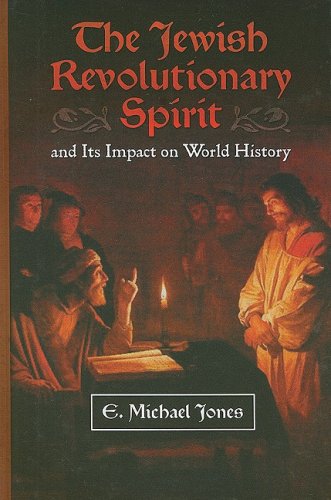
“If you want to advance regime change in Iran, you don’t have to go through the C.I.A. cloak-and-dagger stuff — what you want to do is take very large, very strong transponders and just beam ‘Melrose Place’ and ‘Beverly Hills 2050’ and all that into Tehran and into Iran, because that is subversive stuff. They watch it — the young kids watch it, the young people. They want to have the same nice clothes and the same houses and swimming pools and so on.â€[11]E. Michael Jones, The Jewish Revolutionary Spirit and Its Impact on World History (South Bend: Fidelity Press, 2008), 1055.
Netanyahu is not stupid. He knows that this kind of “subversive” behavior can ruin lives and has ruined lives before. He also knows that Samson, one of Israel’s heroes, was eventually defeated by the same kind of influence. As you write in The Jewish Revolutionary Spirit: “Samson and Delilah is a good place to start. Israel was invincible military…so the Philistines decided to get the Israelite leader by other than military means. They seduced him sexually. Once Samson succumbed to Delilah’s wiles, he lost his power, and Israel lost its leader. He was no longer on the field of battle, but rather, to use Milton’s phrase, ‘eyeless in Gaza, grinding at the mill with slaves.’â€[12]E. Michael Jones, The Jewish Revolutionary Spirit and Its Impact on World History (South Bend: Fidelity Press, 2008), 1055.
So, Netanyahu was not lying this time. He understands that sexual ideology can be a powerful and disruptive force and can easily be weaponized. In his view, once a person gives in to it, he can become controlled by those who influence and manipulate him.
If we follow this argument to its logical conclusion, then people like David Cronenberg, Eli Roth, Stanley Kubrick, Roman Polanski, and others understand that they are influencing their audiences by producing this kind of “subversive” material. Under the banners of “democracy” and “freedom,” they are able to gradually remove morality or practical reason from the public sphere and replace it with pornography and sexual liberation, thereby making the masses easier to influence and control. This is a dangerous and destructive idea, and people like Augustine understood that long ago. As you quote Augustine saying:
“Thus, a good man, though a slave, is free; but a wicked man, though a king, is a slave. For he serves, not one man alone, but, what is worse, as many masters as he has vices.â€
The logic behind this principle is fairly simple: whenever morality is removed from the life of an individual or from the public square, man will inevitably begin to live according to his basic desires and instincts. This is where Darwinian ideology fails because Darwin himself saw no fundamental difference between man and animal.[13]For a study on this, see for example Janet Browne, Charles Darwin: A Biography (Princeton: Princeton University Press, 1996); Adrian Desmond and James Moore, Darwin: The Life of a Tormented Evolutionist (New York: W. W. Norton, 1991). Man is unique because he can understand the moral order and choose to respond to it. Moreover, man is a moral being. As you argue,
“Morality is reason in the practical order. Anything which undermines morality undermines reason, and without reason man is no better than the animals which, Malthus discovered, procreate themselves into extinction unless checked by nature. Man without morals is in precisely the same situation as the bacteria in the bucket, which became the paradigm of Malthus’s geometric population growth, a view which he himself rejected solely because it failed to take into account man’s reason and his ability to calculate future consequences.â€[14]Jones, Libido Dominandi, 599.
(For a study on this, see for example Janet Browne, Charles Darwin: A Biography (Princeton: Princeton University Press, 1996); Adrian Desmond and James Moore, Darwin: The Life of a Tormented Evolutionist (New York: W. W. Norton, 1991).)
What we have seen over the past 60 years or so is that the people and institutions that control much of America and the West have largely removed practical reason from the culture and unleashed a wave of sexual ideology that has weakened the foundations of society. Take, for example, Bitter Moon, directed by Roman Polanski. In the film, Oscar Benton dreams of becoming a writer, but that dream comes to an abrupt end when he catches sight of a woman named Fiona Dobson on a bus. As he describes it,

ORDER IT NOW
“Paris, my dream city. Hemingway, Miller, Scott Fitzgerald, I was determined to follow in their footsteps—maybe too determined for my own good…Paris was heaven, until that day on the bus….It was no good. I couldn’t write, couldn’t sleep, couldn’t get her out of my mind.â€
That glimpse on the bus led Benton to what he called “new possibilities,†which, of course, included sexual experiences and explorations, such as being “humiliated by a beautiful woman.â€
To make a long story short, Benton eventually admitted that he had been completely “demolished by a love that was too strong.” What he really meant was that he had been controlled by his own sexual desires and unchecked passions. Over time, those passions led him into other areas, including sadomasochism, sexual bondage, and voyeurism. Benton admitted that he was “completely enslaved, body and soul,” by his own sexual impulses. Those impulses first crippled him morally and eventually took a physical toll on him as well.
In the end, Benton was consumed by his uncontrolled lust, which ultimately led to his tragic downfall and pathetic death. Surely Polanski understood that Bitter Moon dealt with deeply subversive themes. Even Slant, a magazine that generally celebrates Hollywood films, described the movie as a form of “perversion.â€
If there is one lesson to be learned from this portrayal of perversion, it is that unchecked lust and unrestrained sexual passion can ultimately lead to self-destruction. That, at least, is the lesson reflected in the story of Samson and many other tragic figures throughout history and literature. But it is this kind of perversion that ends up corrupting people like Lisa Palac, the author of The Edge of the Bed: How Dirty Pictures Changed My Life. Palac wrote: “Pop culture glued me to my friends, expanded my vocabulary and, of course, tipped me off to big worlds of sexual possibilities. It was the type of sex education where I learned through suggestion and nuance.â€[15]Quoted in Jones, Libido Dominandi, 263.
(For a study on this, see for example Janet Browne, Charles Darwin: A Biography (Princeton: Princeton University Press, 1996); Adrian Desmond and James Moore, Darwin: The Life of a Tormented Evolutionist (New York: W. W. Norton, 1991).)
The “big worlds of sexual possibilities†included pornography, which Palac saw as a turning point in her life: “Once I figured out how to use porn and come—how to look at an erotic image and use my sexual imagination to turn desire into a self-generated orgasm—my life was irrevocably and positively changed.â€[16]Ibid., 588.
(For a study on this, see for example Janet Browne, Charles Darwin: A Biography (Princeton: Princeton University Press, 1996); Adrian Desmond and James Moore, Darwin: The Life of a Tormented Evolutionist (New York: W. W. Norton, 1991).)
What is the lesson of the story? It is no accident that some Jewish writers, lawyers, and organizations have attacked restrictions and the band of pornography in films and other forms of media.[17]See for example Josh Lambert, Unclean Lips: Obscenity, Jews, and American Culture (New York: New York University Press, 2014); Nathan Abrams, The New Jew in Film: Exploring Jewishness and Judaism in Contemporary Cinema (Piscataway: Rutgers University Press, 2012). They know that pornography is harmful and addictive, and many studies have raised concerns about its effects on individuals and relationships.[18]See for example Mary Eberstadt and Mary Anne Layden, The Social Costs of Pornography (New York and Barcelona: The Whitherspoon Institute, 2010); Gail Dimes, Pornland: How Porn Has Hijacked Our Sexuality (Boston: Beacon Press, 2010); Pamela Paul, Pornified: How Pornography Is Damaging Our Lives, Our Relationships, and Our Families (New York: St. Martin’s Press, 2006); William M. Struthers, Wired for Intimacy: How Pornography Hijacks the Mail Brain (Downer Grove, IL: IVP, 2009). Pornography has even been described by some studies as being more harmful and powerful than crack cocaine.[19]“Porn Panic Over Eroto-Toxins,†New Scientist, November 27, 2004. One medical expert by the name of Jeffrey Satinover of Princeton declared that pornography “does what heroin can’t do.â€[20]Ibid.
(“Porn Panic Over Eroto-Toxins,†New Scientist, November 27, 2004.)
Research has suggested that pornography may initially increase people’s interest in sex, but over time it ruins sexual relationships and intimacy. In The Brain That Changes Itself, Norman Doidge discusses some of the potential effects of pornography on the brain and behavior. Some researchers, including neurosurgeon Donald L. Hilton of the University of Texas, have argued that prolonged exposure to pornography may cause changes in the brain that can be harmful.[21]Donald L. Hilton, “Slave Master,†Salvo Magazine, Summer 2010.
Why haven’t these studies led to the closure of the pornography industry? One possible answer is money. The pornography industry generates billions of dollars in revenue each year, giving powerful financial interests a reason to keep it operating despite concerns about its social and personal effects.[22]Donald L. Hilton and Clark Watts, “Pornography Addiction: A Neuroscience Perspective,†Surgical Neurological International, February 21, 2011; see also Peter Fleming, Sara Louise Muhr, and Masoud Shadnam, “The business of pornography: Contributions from organization studies—Introduction to the special section,†Sage Journals, Vol. 31, issue 5: June 20, 2024. Moreover, this brings us full circle. Capitalism, which Darwinism has historically supported, also ends up supporting the pornography industry because it treats pornography as a profitable business or “laissez-faire economics.â€[23]Alan Alan, “Pornography as a Creative Industry: Challenging the Exceptionalist Approach to Pornography,†Porn Studies 3, no. 2 (2016): 107–119; Laura McVey, Meagan Tyler, and Lauren Gurrieri, “‘Care’ as camouflaging capitalism and obscuring harm: The user-generated pornography market and women’s inequality,†Sciencedirect.com, Vol. 91, March-April 2022; Eric George, Digitalization of Society and Socio-Political Issues 1: Digital, Communication and Culture (Hoboken, NJ: John Wiley & Sons, 2019), 129-137.
If capitalism depends on endless economic growth, and pornography contributes to that growth, then what mechanism can be used to stop pornography? According to libertarian principles, pornography should not be restricted. This is where libertarianism faces a serious challenge.
In fact, one of the most influential figures in the twentieth-century libertarian movement was Murray Rothbard. In his book For a New Liberty: The Libertarian Manifesto, first published in 1973, Rothbard expressed the following view:
ORDER IT NOW
“If no man may aggress against another; if, in short, everyone has the absolute right to be ‘free’ from aggression, then this at once implies that the libertarian stands foursquare for what are generally known as ‘civil liberties’: the freedom to speak, publish, assemble, and to engage in such ‘victimless crimes’ as pornography, sexual deviation, and prostitution (which the libertarian does not regard as ‘crimes’ at all, since he defines a ‘crime’ as violent invasion of someone else’s person or property).â€[24]Murray N. Rothbard, For a New Liberty: The Libertarian Manifesto (Auburn, AL: Ludwig von Mises Institute, 1973, 1978 and 2006), 27.
The libertarian position ultimately stands or falls on this premise. Can pornography really be considered a “victimless crime� If study after study shows that pornography is linked to depression, anxiety, stress, loneliness, lower self-esteem, and poorer psychological well-being,[25]Claudio Vieira and Mark D. Griffiths, “Problematic Pornography Use and Mental Health: A Systematic Review,†Sexual Health & Compulsivity, 31(3), 207–247, May 10, 2024: https://www.tandfonline.com/doi/full/10.1080/2692995...48624. and that it can increase conflict in relationships and reduce intimacy,[26]Cynthia Perovano Camargo Baumel , Valeschka Martins Guerra , Agnaldo Garcia , Alini Gusmão do Rosário, “Pornography Consumption and Relationship: A Systematic Review of 2006–2015,†The Journal of Sexual Medicine, Volume 14, May 1, 2017: https://doi.org/10.1016/j.jsxm.2017.04.545. See also “Adolescents, Pornography Use, and Problematic Pornography Use: A Rapid Systematic Review of Longitudinal Studies,†Journal of the Korean Academy of Child and Adolescent Psychiatry, 2025, vol.36, no.3: 122-134; Gemma Mestre-Bach,Alejandro Villena-Moya, Carlos Chiclana-Actis, “Pornography Use and Violence: A Systematic Review of the Last 20 Years,†Sage Journals, June 13, 2023. can anyone reasonably claim that there are no victims? What evidence did Rothbard provide to support his argument? None. And if pornography itself is not a crime, what about child pornography? Should adults be arrested for possessing child pornography on their computers?
You see, Rothbard, whether he realized it or not, was making a case similar to that of Magnus Hirschfeld, the Jewish sexologist and revolutionary who promoted sexual liberalization in Germany, particularly in Berlin, during the 1920s and 1930s. Taking the argument a step further, Rothbard was also providing an ideological framework that has allowed cultural elites and Jewish revolutionaries to promote sexual liberation in America. Anyone who doubts this should consider Josh Lambert’s book Unclean Lips: Obscenity, Jews, and American Culture, which examines the role the Jews have played in attacking practical reason in American cultural life.
Long before Rothbard advanced this thesis, Joseph Daniel Unwin argued in his 1934 study Sex and Culture that: 1) Civilizations tend to reach their highest levels of cultural creativity and expansion when they maintain strict sexual norms; 2) As societies become more sexually permissive, their social cohesion and cultural energy tend to decline; and 3) Greater sexual freedom eventually leads to social stagnation and decline.[27]J. D. Unwin, Sex and Culture (Oxford: Oxford University Press, 1934). In 1956, Pitirim A. Sorokin, a sociologist at Harvard University, argued much the same thing in his study The American Sex Revolution.[28]Pitirim A. Sorokin, The American Sex Revolution (Boston: Porter Sargent Publisher, 1956).
Was Rothbard aware of these studies? We do not know. What is clear is that he did not address them. Libertarian principles were so central to his thinking that he offered little serious evidence for many of the claims he made in his book.
If we take his position to its logical conclusion, one could argue that consensual sexual relationships between adults and minors should be judged primarily in terms of individual freedom rather than broader moral or social concerns. In that sense, Rothbard may not have realized that his argument could be used by pedophiles like Jeffrey Epstein seeking to justify or defend abusive sexual relationships.
If individual freedom is treated as the highest principle, it becomes difficult to explain where limits should be drawn and why certain sexual relationships should be prohibited. The central question, then, is whether liberty alone provides a sufficient foundation for moral and legal judgments, or whether other principles—such as protection of the vulnerable, social well-being, and moral responsibility—must also be taken into account.
Here we encounter what may be the complete failure of the libertarian concept of freedom. Libertarians such as Rothbard think that freedom allows individuals to make choices as long as they do not violate the rights of others. This view permits people to act against what Immanuel Kant called the categorical imperative, or the demands of practical reason and moral duty. Freedom is not the ability to do whatever one desires. Rather, true freedom is the ability to choose what is right and in accordance with the moral law, which is universally binding and which is the opposite of what the Darwinian ideology proposes. Actions that violate moral principles are not genuine expressions of freedom but the opposite of it. Libertarianism turns this understanding upside down by indirectly separating freedom from moral responsibility.
Yes, libertarians often use terms such as “morality,†“rights,†and “freedom.†However, the meanings they attach to these words are very different from the metaphysical understanding of morality. From a metaphysical standpoint, morality is grounded in objective moral principles and duties, whereas libertarianism tends to reduce morality to individual choice and personal autonomy. As a result, libertarians end up defending positions that are contrary to what morality actually is. Rothbard writes:
“All of these positions are now considered ‘leftist’ on the contemporary ideological scale. On the other hand, since the libertarian also opposes invasion of the rights of private property, this also means that he just as emphatically opposes government interference with property rights or with the free-market economy through controls, regulations, subsidies, or prohibitions…hence, a system of ‘laissez-faire capitalism.’â€[29]Rothbard, For a New Liberty, 27-28.
In other words, the government should not interfere if people like Jeff Bezos make billions upon billions of dollars while paying no income taxes. In fact, in both 2007 and 2011, Bezos paid zero federal income taxes. “In 2018, Tesla founder Elon Musk, the second-richest person in the world, also paid no federal income taxes. Michael Bloomberg managed to do the same in recent years. Billionaire investor Carl Icahn did it twice. George Soros paid no federal income tax three years in a row…The IRS records show that the wealthiest can — perfectly legally — pay income taxes that are only a tiny fraction of the hundreds of millions, if not billions, their fortunes grow each year.â€[30]“The Secret IRS Files: Trove of Never-Before-Seen Records Reveal How the Wealthiest Avoid Income Tax,†https://www.propublica.org/article/the-secret-irs-fi...e-tax.
Can you imagine ordinary Americans trying to avoid paying taxes without facing the threat of government penalties, imprisonment, or other serious consequences? Yet wealthy individuals often have access to legal strategies and resources that allow them to reduce their tax burdens in ways that are not available to most people. “America’s billionaires avail themselves of tax-avoidance strategies beyond the reach of ordinary people. Their wealth derives from the skyrocketing value of their assets, like stock and property. Those gains are not defined by U.S. laws as taxable income unless and until the billionaires sell.â€[31]Ibid.
(“The Secret IRS Files: Trove of Never-Before-Seen Records Reveal How the Wealthiest Avoid Income Tax,†https://www.propublica.org/article/the-secret-irs-fi...e-tax.)
Rothbard was simply out of his depth. Throughout history, wealthy and powerful groups have often used their economic influence in ways that weakened family life or contributed to periods of economic stagnation. Yet many people continue to believe that society prospers when the rich pay little or no taxes. Rothbard’s ideas might have been dismissed long ago had he not given many people something attractive to hold on to. For example, he argued that war is a form of mass killing and that states have repeatedly engaged in large-scale violence throughout history. These arguments resonated with many readers. At the same time, however, Rothbard also described taxation as a form of robbery.[32]Ibid., 29.
(“The Secret IRS Files: Trove of Never-Before-Seen Records Reveal How the Wealthiest Avoid Income Tax,†https://www.propublica.org/article/the-secret-irs-fi...e-tax.) But robbery from whom? From the rich, who often have the resources to reduce their tax burdens through legal means?
In short, the libertarian principle has neither a solid moral foundation nor a convincing intellectual basis, despite the fact that many of its leading advocates present it as a consistent moral system. For example, in his 1976 book Defending the Undefendable, Jewish libertarian Walter Block argued that people commonly condemned by society—including pimps, prostitutes, strikebreakers, slumlords, libelers, and moneylenders—deserve a defense. According to Block, these individuals should be judged not by popular opinion but by whether they violate the rights of others.[33]Walter Block, Defending the Undefendable: The Pimp, Prostitute, Scab, Slumlord, Libeler, Moneylender, and Other Scapegoats in the Rogue’s Gallery of American Society (Auburn, AL: Ludwig von Mises Institute, 1976, 1991, and 2008).
The foreword to Block’s book was written by Rothbard, and it also received a favorable endorsement from F. A. Hayek, one of the most influential libertarian and free-market thinkers of the twentieth century. Hayek’s book, The Road to Serfdom, became a classic among libertarians and advocates of the free market. In the book, Block defends a wide range of crooks in society, including what he calls “the fat capitalist-pig employer,” “the employer of child labor,” “the rate buster,” “the profiteer,” “the ghetto merchant,” “the slumlord,” “the moneylender,” and even “the (non-government) counterfeiter.”
In other words, this system resembles ideas that Jewish revolutionary movements have supported throughout history. This argument is developed by E. Michael Jones in his books The Jewish Revolutionary Spirit and Its Impact on World History and Barren Metal: A History of Capitalism as the Conflict Between Labor and Usury, where he contends that Jewish revolutionary movements and modern capitalism have often shared common interests in weakening moral, social and economic structures in much of the West.
In the foreword to Block’s book, Rothbard repeats the central libertarian principle by arguing that: “Fearlessly, and with logic and trenchant wit, Professor Block rehabilitates and demonstrates the considerable economic merits of such scapegoat occupations as the pimp, the blackmailer, and the slumlord.â€[34]Ibid., ix.
(Walter Block, Defending the Undefendable: The Pimp, Prostitute, Scab, Slumlord, Libeler, Moneylender, and Other Scapegoats in the Rogue’s Gallery of American Society (Auburn, AL: Ludwig von Mises Institute, 1976, 1991, and 2008).) According to libertarian principles, the profiteer, the “fat capitalist-pig employer,” the rate buster, the usurer, and many other figures who have historically been criticized as exploiters of the poor or obstacles to economic justice are not villains at all. As Rothbard put it in his foreword to Block’s book, they are “heroes, but not necessarily saints..â€[35]Ibid., xi.
(Walter Block, Defending the Undefendable: The Pimp, Prostitute, Scab, Slumlord, Libeler, Moneylender, and Other Scapegoats in the Rogue’s Gallery of American Society (Auburn, AL: Ludwig von Mises Institute, 1976, 1991, and 2008).) Rothbard concludes his forward by saying, “If you don’t like the idea of a usurer or a slumlord being a hero, then the only way to deprive him of this stature is to remove the shackles that misguided people have placed upon him.â€[36]Ibid.
(Walter Block, Defending the Undefendable: The Pimp, Prostitute, Scab, Slumlord, Libeler, Moneylender, and Other Scapegoats in the Rogue’s Gallery of American Society (Auburn, AL: Ludwig von Mises Institute, 1976, 1991, and 2008).) What Rothbard ends up saying indirectly here is that Yuri Slezkine’s thesis that the twentieth century is the Jewish century is actually correct.[37]Yuri Slezkine, The Jewish Century (Princeton: Princeton University Press, 2006).
Now, I appreciate Rothbard and especially Block for some intellectual consistency, because they were willing to follow libertarian principles to their logical conclusions, regardless of how bitter those conclusions might be. They were willing to accept the implications of their ideology. In that respect, they can be compared to thinkers such as Friedrich Nietzsche and Jean-Paul Sartre, who followed their own philosophical premises to their logical and bitter conclusions. Likewise, Rothbard argued in his introduction to Block’s book that anyone who takes the principles of Adam Smith seriously should arrive at similar conclusions. As Rothbard put it, “the Smithian principles work even in these cases†that Block discusses in his book.
ORDER IT NOW
In other words, if Smithian and libertarian principles are carried to their logical conclusion, one eventually ends up defending rapacious profiteers, blackmailers, pimps, pornographers, prostitutes, and many others. The same principles can also be used to justify the constant search for cheaper labor and fewer economic restrictions. This creates pressure for large-scale immigration because businesses benefit from a larger labor pool and lower labor costs. This process has historically weakened the bargaining power of workers and created economic difficulties for citizens. Whether one agrees with this conclusion or not, the argument is that libertarian principles can lead to outcomes that their supporters either overlook or are unwilling to acknowledge.
In fact, there is a substantial body of historical and economic research showing that many business elites, industrialists, and employer groups have often supported immigration because it increases the supply of cheap labor and can help reduce labor costs. If companies are not required to pay a living wage—a wage sufficient to support a family and contribute to the long-term stability of society—they will naturally seek the cheapest labor available in order to maximize profits and reduce costs. Businesses have a strong incentive to increase the labor supply whenever possible. This dynamic can place downward pressure on wages and weaken the economic position of workers. This pattern was visible in nineteenth-century America, where many employers favored large-scale immigration because it provided a steady source of cheap labor for rapidly expanding industries.[38]See for example Morrell Heald, “Business Attitudes Toward European Immigration, 1880-1900,†The Journal of Economic History, February 3, 2011; Nestor Rodriguez, “’Workers Wanted’: Employer Recruitment of Immigrant Labor,†Sage Journals, Vol. 31, issue 4: November 2004; Kathleen C. Schwartzman, “Lettuce, Segmented Labor Markets, and the Immigration Discourse,†Sage Journals, vol. 39, issue 1: May 8, 2007; George J. Borjas, “The Labor Demand Curve is Downward Sloping: Reexamining the Impact of Immigration on the Labor Market,†National Bureau of Economic Research, June 2003; George Borjas, “Monopsony, Efficiency, and the Regularization of Undocumented Immigrants,†HKS Faculty Research Working Paper Series; HKS Working Paper No. RWP23-019, July 2023. As economic historian Morrell Heald puts it,
“The interest of employers in recruiting cheap labor and strikebreakers from Europe is a familiar story. That industrialists and their allies in the years of rapid expansion and mechanization of the American economy stood to gain as much as any other group, even including the aliens themselves, from the maintenance of large-scale immigration has appeared so obvious as to demand little careful investigation.â€[39]Heald, “Business Attitudes Toward European Immigration, 1880-1900.â€
George J. Borjas, “America’s leading immigration economists†of Harvard, has been writing about this for years.[40]George J. Borjas, Heaven’s Door: Immigration Policy and the American Economy (Princeton: Princeton University Press, 1999); We Wanted Workers: Unraveling the Immigration Narrative (New York: W.W. Norton & Company, 2016).
In his brief endorsement of Block’s book, F. A. Hayek, who won the Nobel Prize in Economics, acknowledged the influence of Ludwig von Mises, stating that “Ludwig von Mises converted me to a consistent free-market position.” Hayek noted that he found Block’s arguments “occasionally incredulous,” but said that he usually found himself agreeing with the book’s central thesis. He then added: “Some may find it too strong a medicine, but it will still do them good even if they hate it.â€[41]Block, Defending the Undefendable, xii.
Once again, we can appreciate the candor of these people. Unlike many advocates of the Darwinian ideology, who often retreat from the logical implications of their own principles when faced with difficult questions, Block and other libertarians were willing to follow their ideas to conclusions that are morally and philosophically troubling. This is precisely what makes Defending the Undefendable so revealing. Rather than avoiding controversial implications, Block openly argues that if libertarian principles are applied consistently, then activities such as pornography, prostitution, and other behaviors regarded as immoral may nevertheless deserve legal protection. In that sense, Block lays out the libertarian system in its most explicit form. This demonstrates that capitalism is not merely a neutral system of economic exchange but also carries moral, social, and political implications. Furthermore, libertarianism benefits the interests of the wealthy and powerful by placing individual economic freedom above practical reason. Block writes, “Taxation is contrary to the basic principle because it involves aggression against nonaggressive citizens who refuse to pay.â€[42]Ibid., xiv.
(Block, Defending the Undefendable, xii.)
If taxation is fundamentally illegitimate, as many libertarians maintain, then it becomes difficult to explain why wealthy individuals should feel any obligation to pay taxes in the first place. If the rich and powerful can avoid taxes through legal loopholes or other means, what principle within the libertarian framework compels them to act differently? Libertarianism obviously creates a self-reinforcing system. The same principles used to defend rapacious profiteers, blackmailers, and other crooks can also be used to defend aggressive tax avoidance and other detrimental practices. As a result, the system leaves little room for broader considerations of social responsibility, the common good, or the flourishing of the average family in any society. In that sense, libertarianism does not merely defend free exchange. Rather, it can function as an ideological justification for conduct that are exploitative, including corporate misconduct, negligence, manipulation, and the pursuit of profit without regard for wider social consequences.
For example, if pharmaceutical companies are deliberately encouraging overmedication or promoting treatments primarily to increase profits, then who is to say that such behavior is wrong?[43]See Ray Moynihan and Alan Cassels, Selling Sickness: How the World’s Biggest Pharmaceutical Companies Are Turning Us All into Patients (New York: Nation Books, 2005); Dennis Miller, The Shocking Truth About Pharmacy: A Pharmacist Reveals All The Disturbing Secrets (Independently Published, 2020); Wouldn’t it be nice if the government stayed out of situations like this, even when companies make the workplace unbearable for workers? Wouldn’t it be nice to apply this so-called “laissez-faire” ideology consistently? Haven’t pharmaceutical companies been doing exactly that for years so they can sell their products, regardless of the risks and side effects? And haven’t they pressured doctors and medical professionals not to tell patients about some of those side effects?[44]See for example John Abramson, Overdosed America: The Broken Promise of American Medicine (New York: HarperCollins, 2004); Peter C. Gøtzsche, Deadly Medicines and Organised Crime: How Big Pharma Has Corrupted Healthcare (UK: Radcliffe Publishing, 2013); David Healy, Pharmageddon (Berkeley and Los Angeles: University of California Press, 2012). Block goes on to propound:
“Libertarians maintain that as far as political theory is concerned, anything which does not involve the initiation of violence is not evil and that as far as political theory is concerned, anything which does not involve the initiation of violence is not a punishable evil and should not be outlawed. And this is the basis for the first part of my argument. The so-called ‘villains’ are not villains at all, in this sense, because they do not initiate violence against nonaggressors.â€[45]Block, Defending the Undefendable, xiv.
What about a grown man having consensual sex with a nine-or ten-year-old girl? Is that evil according to the libertarian premise? If Block wants to remain consistent, he would have to say no. Taking the argument a step further, why is the media still shocked by Jeffrey Epstein’s practice of taking girls to a private island for the rich and powerful? Many of those girls went to the island consensually.
In a similar way, the libertarian system can undermine family formation by defending wages that are too low for an average worker to support a large family. The typical libertarian argues that if Mr. Jones agrees to work for a certain wage, what right does the government have to prevent an employer from paying him that amount? Once again, the libertarian position does not seem to add up.[46]For related topics, see John Rawls, A Theory of Justice (Cambridge: Harvard University Press, 1971 and 1999).
One final argument against the libertarian system is that many libertarians are strongly opposed to war, yet they often fail to condemn the military-industrial complex, the very system that profits from the production of weapons. If there is no war, how will the military-industrial complex continue to make money? And if there is no profit, how can the system sustain itself? The typical libertarian will often dance around this question and come up with ridiculous answers to defend the system.
Notes
[1] E. Michael Jones, Libido Dominandi: Sexual Liberation and Political Control (South Bend: St. Augustine’s Press, 2000), 126-127.
[2] David Bakan, Sigmund Freud and the Jewish Mystical Tradition (New York: Dover Publications, 2004).
[3] Richard Noll, The Jung Cult: Origins of A Charismatic Movement (Princeton: Princeton University Press, 1994); Nandor Fodor, Freud, Jung, and occultism (New York: University Books, 1971).
[4] Gabrielle Kuby, The Global Sexual Revolution: Destruction of Freedom in the Name of Freedom (Kettering, OH: Angelico Press, 2012 and 2015), 16-31.
[5] http://gawker.com/5547523/the-cias-plot-to-make-osama-and-saddam-into-gay-porn-stars.
[6] http://williamblum.org/chapters/killing-hope/indonesia.
[7] Personal correspondence.
[8] For a new study on this, see David A. Wemhoff, John Courtney Murray, Time/Life, and the American Proposition: How the CIA’s Doctrinal Warfare Program Changed the Catholic Church (South Bend: Fidelity Press, 2015)
[9] “Revolutionary Blue,†Time, 12/23/74, Vol. 104, #26, p. 41.
[10] Quoted in Robert Mackey, “Kerry Reminds Congress Netanyahu Advised U.S. to Invade Iraq,†NY Times, February 25, 2015.
[11] E. Michael Jones, The Jewish Revolutionary Spirit and Its Impact on World History (South Bend: Fidelity Press, 2008), 1055.
[12] E. Michael Jones, The Jewish Revolutionary Spirit and Its Impact on World History (South Bend: Fidelity Press, 2008), 1055.
[13] For a study on this, see for example Janet Browne, Charles Darwin: A Biography (Princeton: Princeton University Press, 1996); Adrian Desmond and James Moore, Darwin: The Life of a Tormented Evolutionist (New York: W. W. Norton, 1991).
[14] Jones, Libido Dominandi, 599.
[15] Quoted in Jones, Libido Dominandi, 263.
[16] Ibid., 588.
[17] See for example Josh Lambert, Unclean Lips: Obscenity, Jews, and American Culture (New York: New York University Press, 2014); Nathan Abrams, The New Jew in Film: Exploring Jewishness and Judaism in Contemporary Cinema (Piscataway: Rutgers University Press, 2012).
[18] See for example Mary Eberstadt and Mary Anne Layden, The Social Costs of Pornography (New York and Barcelona: The Whitherspoon Institute, 2010); Gail Dimes, Pornland: How Porn Has Hijacked Our Sexuality (Boston: Beacon Press, 2010); Pamela Paul, Pornified: How Pornography Is Damaging Our Lives, Our Relationships, and Our Families (New York: St. Martin’s Press, 2006); William M. Struthers, Wired for Intimacy: How Pornography Hijacks the Mail Brain (Downer Grove, IL: IVP, 2009).
[19] “Porn Panic Over Eroto-Toxins,†New Scientist, November 27, 2004.
[20] Ibid.
[21] Donald L. Hilton, “Slave Master,†Salvo Magazine, Summer 2010.
[22] Donald L. Hilton and Clark Watts, “Pornography Addiction: A Neuroscience Perspective,†Surgical Neurological International, February 21, 2011; see also Peter Fleming, Sara Louise Muhr, and Masoud Shadnam, “The business of pornography: Contributions from organization studies—Introduction to the special section,†Sage Journals, Vol. 31, issue 5: June 20, 2024.
[23] Alan Alan, “Pornography as a Creative Industry: Challenging the Exceptionalist Approach to Pornography,†Porn Studies 3, no. 2 (2016): 107–119; Laura McVey, Meagan Tyler, and Lauren Gurrieri, “‘Care’ as camouflaging capitalism and obscuring harm: The user-generated pornography market and women’s inequality,†Sciencedirect.com, Vol. 91, March-April 2022; Eric George, Digitalization of Society and Socio-Political Issues 1: Digital, Communication and Culture (Hoboken, NJ: John Wiley & Sons, 2019), 129-137.
[24] Murray N. Rothbard, For a New Liberty: The Libertarian Manifesto (Auburn, AL: Ludwig von Mises Institute, 1973, 1978 and 2006), 27.
[25] Claudio Vieira and Mark D. Griffiths, “Problematic Pornography Use and Mental Health: A Systematic Review,†Sexual Health & Compulsivity, 31(3), 207–247, May 10, 2024: https://www.tandfonline.com/doi/full/10.1080/26929953.2024.2348624.
[26] Cynthia Perovano Camargo Baumel , Valeschka Martins Guerra , Agnaldo Garcia , Alini Gusmão do Rosário, “Pornography Consumption and Relationship: A Systematic Review of 2006–2015,†The Journal of Sexual Medicine, Volume 14, May 1, 2017: https://doi.org/10.1016/j.jsxm.2017.04.545. See also “Adolescents, Pornography Use, and Problematic Pornography Use: A Rapid Systematic Review of Longitudinal Studies,†Journal of the Korean Academy of Child and Adolescent Psychiatry, 2025, vol.36, no.3: 122-134; Gemma Mestre-Bach,Alejandro Villena-Moya, Carlos Chiclana-Actis, “Pornography Use and Violence: A Systematic Review of the Last 20 Years,†Sage Journals, June 13, 2023.
[27] J. D. Unwin, Sex and Culture (Oxford: Oxford University Press, 1934).
[28] Pitirim A. Sorokin, The American Sex Revolution (Boston: Porter Sargent Publisher, 1956).
[29] Rothbard, For a New Liberty, 27-28.
[30] “The Secret IRS Files: Trove of Never-Before-Seen Records Reveal How the Wealthiest Avoid Income Tax,†https://www.propublica.org/article/the-secret-irs-files-trove-of-never-before-seen-records-reveal-how-the-wealthiest-avoid-income-tax.
[31] Ibid.
[32] Ibid., 29.
[33] Walter Block, Defending the Undefendable: The Pimp, Prostitute, Scab, Slumlord, Libeler, Moneylender, and Other Scapegoats in the Rogue’s Gallery of American Society (Auburn, AL: Ludwig von Mises Institute, 1976, 1991, and 2008).
[34] Ibid., ix.
[35] Ibid., xi.
[36] Ibid.
[37] Yuri Slezkine, The Jewish Century (Princeton: Princeton University Press, 2006).
ORDER IT NOW
[38] See for example Morrell Heald, “Business Attitudes Toward European Immigration, 1880-1900,†The Journal of Economic History, February 3, 2011; Nestor Rodriguez, “’Workers Wanted’: Employer Recruitment of Immigrant Labor,†Sage Journals, Vol. 31, issue 4: November 2004; Kathleen C. Schwartzman, “Lettuce, Segmented Labor Markets, and the Immigration Discourse,†Sage Journals, vol. 39, issue 1: May 8, 2007; George J. Borjas, “The Labor Demand Curve is Downward Sloping: Reexamining the Impact of Immigration on the Labor Market,†National Bureau of Economic Research, June 2003; George Borjas, “Monopsony, Efficiency, and the Regularization of Undocumented Immigrants,†HKS Faculty Research Working Paper Series; HKS Working Paper No. RWP23-019, July 2023.
[39] Heald, “Business Attitudes Toward European Immigration, 1880-1900.â€
[40] George J. Borjas, Heaven’s Door: Immigration Policy and the American Economy (Princeton: Princeton University Press, 1999); We Wanted Workers: Unraveling the Immigration Narrative (New York: W.W. Norton & Company, 2016).
[41] Block, Defending the Undefendable, xii.
[42] Ibid., xiv.
[43] See Ray Moynihan and Alan Cassels, Selling Sickness: How the World’s Biggest Pharmaceutical Companies Are Turning Us All into Patients (New York: Nation Books, 2005); Dennis Miller, The Shocking Truth About Pharmacy: A Pharmacist Reveals All The Disturbing Secrets (Independently Published, 2020);
[44] See for example John Abramson, Overdosed America: The Broken Promise of American Medicine (New York: HarperCollins, 2004); Peter C. Gøtzsche, Deadly Medicines and Organised Crime: How Big Pharma Has Corrupted Healthcare (UK: Radcliffe Publishing, 2013); David Healy, Pharmageddon (Berkeley and Los Angeles: University of California Press, 2012).
[45] Block, Defending the Undefendable, xiv.
[46] For related topics, see John Rawls, A Theory of Justice (Cambridge: Harvard University Press, 1971 and 1999).
| # | Наименование новости | Тональность | Информативность | Дата публикации |
|---|---|---|---|---|
| 1 | "Mene Mene Tekel Uparsin", by E. Michael Jones | 0 | 6.05 | 05-04-2026 |
| 2 | The Day of the Jackal 2.0, by E. Michael Jones | 0 | 19.88 | 25-06-2026 |
| 3 | ‘LITERALLY INSANE’: Van Jones Unloads on Far-Left DSA Ideas — ‘Stop Pooping in the Punch Bowl!’ | 0 | 15.61 | 20-07-2026 |
| 4 | A hot poker to the Achilles tendon for lazy housework or mauled to death by lions: the life of a Roman slave | -2 | 7 | 14-06-2026 |
| 5 | The Private Life Of A Nymphomaniac | 0 | 0 | 09-04-2026 |
| 6 | Bestselling author Alex Berenson: The Left is destroying families and fathers | -5 | 6 | 01-07-2026 |
| 7 | This is Your Organization: A Conversation with ASHEcon Executive Director David Slusky | 0 | 14.78 | 01-06-2026 |
| 8 | Why Does Okinawa Have So Many US Military Bases? | 0 | 5 | 29-05-2026 |
| 9 | Book Review; Black AF History is the Version We Need. | 0 | 5.82 | 24-03-2026 |
| 10 | Eric Zorn: The Democratic party is a wounded brand | 0 | 6.1 | 11-08-2026 |