Просмотр новости
Найдите то, что Вас интересует
 Спутники
 РН
РН SpaceX
 Роскосмос
 NASA
NASA
СпутникиРНSpaceXРоскосмосNASAMost of Illinois' local municipal pensions are distressed and hundreds are deeply distressed, imposing a costly drag on the towns and cities that sponsor them.
By: Mark Glennon*
Most Illinois towns and cities maintain their own separate, public pensions for police and firefighters, funded by their local taxpayers along with contributions from the covered workers. They are commonly referred to as the “downstate” pensions, though they are for municipalities throughout the state, excluding only Chicago and several Cook County area pensions.
This column summarizes two reports provided by the state on those 654 downstate local pensions: The December 2025 Report on the Financial Condition of the Downstate Police and Fire from the Commission on Government Forecasting and Accountability (the COGFA Report) and the October 2025 Report on the Financial Condition of the Downstate Police and Fire by the Illinois Department of Insurance (the IDOI Report).
Generally speaking, the financial condition of Illinois’ local police and fire pension funds remains alarmingly weak, with pressure likely to intensify as municipalities work toward the state’s 2040 funding target. Most of Illinois’ local municipal pensions are distressed and hundreds are deeply distressed, imposing a costly drag on the towns and cities that sponsor them.
Before we begin, here are a few things to keep in mind regarding the numbers in those reports that are covered herein:
The official numbers are summarized in the chart below. At first glance, the three-year change may appear modest because average funded ratios deteriorated only slightly.
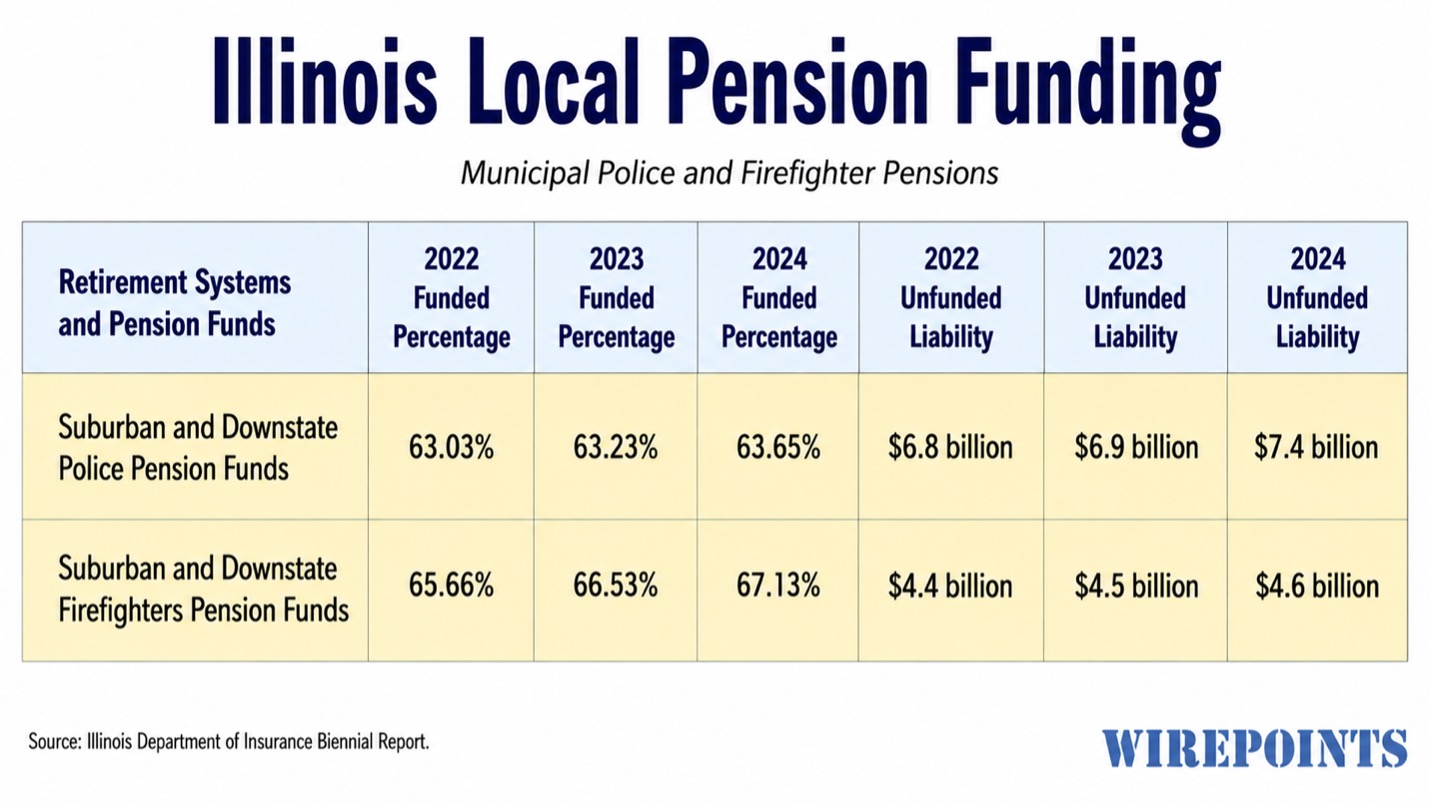 But an unambiguously dire state of affairs is in fact represented by those numbers, for several reasons.
First, pension actuaries regard a funded ratio of sixty-some percent, which is the average for the local pensions, as severely underfunded, and the more unfunded a pension is the more it costs just to tread water. That’s because the investment isn’t there that’s needed even to cover interest that effectively accrues on the unfunded liability along with newly earned benefits. To stay even, taxpayers must contribute the shortfall every year.
Second, averages can be deceiving. Behind those averages are many funds in far worse condition. Over 200 of those pensions are less than 60% funded. That’s severe. About 100 have less than half of what they should have on hand, which is worse than severe.
You can sort those numbers as you’d like with the spreadsheet we made using the IDOI Report’s data. That report contains still more detail on each of local pensions. As you look through it you may be pleased if you see that your own town’s pension is 80% funded or more, since it’s often said that 80% is adequate. But that’s in fact a myth. Anything below full funding generally requires additional contributions to prevent the shortfall from growing, absent offsetting changes in assumptions, benefits, or investment performance. The American Academy of Actuaries, among many others, has tried to dispel the myth as seen in this issue brief.
Third, the pensions were bolstered by exceptionally good financial markets. Total returns for S&P500 stocks from 2022 through 2024 were about 29%. That can’t continue indefinitely.
The ultimate consequence was predictable: The local pensions consume inordinate portions of local property taxes – about 20%, on average, according to a study by the Illinois Policy Institute.
It’s worse than that in many cities. These illustrations are not unique:
In Decatur, three-fourths of the city’s property tax collections go to police and fire pensions.
For the City of Des Plaines 21.3% of the City’s General Fund goes toward police and fire pensions, but note the jump. It was just 7.7% in 2007.
Even in prosperous Highland Park, police and fire pensions consume 27% of the city/library property-tax levy.
Springfield’s entire property tax collections are consumed by pension costs.
Rockford’s combined police and fire unfunded liability is just under a whopping $500 million with the fire pension only 44% funded and the police pension about 51% funded. Its 2026 budget public-safety pension contribution jumped $5 million in one year to $40.5 million. The city notes that the contribution was only $9.6 million in 2013.
Rockford illustrates a key part of the problem. State law requires municipalities to bring public safety pension funds across the state to 90% funding by 2040, which will continue to increase required city contributions. Projections show annual Rockford contributions could reach approximately $44 million for the fire pension fund and $39 million for the police pension fund by 2040, per WQFR in Rockford.
All local pensions face that unfunded mandate of 90% funding by 2040.
One piece of good news is that the state completed its consolidation of local pension management of investment activities at the end of 2024. There’s no substantive consolidation – no pension is taking on the liabilities or assets of another – but consolidating the investment function was prudent, as we wrote earlier. It made no sense to have duplicative management for smaller pensions. Consolidation allows for more flexibility in making longer-term investments and is better handled by one large, professional staff. Potential savings were estimated at $164 million to $500 million per year in total statewide when the consolidation law was passed in 2020. That’s good, but not enough to have a serious impact.
*****************
In one sense, local police and firefighters are not a big part of the pension crisis in Illinois. Their combined unfunded liability of about $12 billion is dwarfed by state and Chicago-area pensions which have a total unfunded burden exceeding $200 billion. (And Chicago’s police and firefighter pensions are a separate story, having a catastrophically low funded ratio of about 25%.)
However, the cost of Illinois’ 654 local pensions is mainly hitting Illinois taxpayers where they are already hurting most – property taxes, which are the highest in the nation. The pain will continue and seems likely to worsen at least at the pace we’ve seen over the years covered in this column.
*Mark Glennon is founder of Wirepoints.